

What an LED Work Light Manufacturer Cannot Prove With a Catalogue
A catalogue and a quotation tell you what a supplier wants to sell you. They do not tell you which legal entity takes the order, which plant builds your model, or what the fifth batch will look like when it arrives. Those three answers decide whether a first order is safe.
The nine checks below close that gap, and verify a supplier before you order in the order a first order moves. Run them in the order a first order moves: entity, quality system, product approval, test conditions, parts, equipment, outgoing records, sample approval and commercial terms. The same nine questions work for any LED work light manufacturer, whatever the size of the plant.
Work through the table with the supplier in front of you and mark each row as document held, verbal only, or not produced. A document held is in your folder; a verbal answer has nothing behind it; a missing answer means you are deciding without it.
| Check | What you verify | Document or observation | If it cannot be produced |
|---|---|---|---|
| 1 · Entity and plant | Name, address, production site | Licence, declaration, bank account | Hold the deposit until one entity owns all three |
| 2 · Quality certificate | Issuing body, scope, edition | Certificate plus transition notice | Fall back to IQC, IPQC, OQC and one corrective action |
| 3 · Certificate covers market and model | Holder, directive, standard editions, model list, plant address | Certificate with the model list attached; worked example in Check 3 | Get written confirmation from the issuing body that your suffix is covered before you settle price |
| 4 · Photometric reports | Method, conditions, sample number | Report with a conditions column | Request the IES or LDT file and sample number |
| 5 · Part traceability | LED bin, driver, connector | Redacted BOM fragment and one IQC record | Write locked part numbers and a substitution clause |
| 6 · Equipment and standards | Equipment IDs, calibration, standard | Equipment list against report IDs | Visit the line or ask for a walk-through video |
| 7 · Outgoing inspection | AQL, sampling plan, reject column | Three months of records with batch numbers | Make batch numbers a shipping-document condition |
| 8 · Sample approval | Golden sample, tolerances, change control | Signed sample, specification, change clause | Treat the order as unapproved until all three exist |
| 9 · Commercial terms | Warranty scope, failure analysis, spares | Warranty text, one failure analysis, spares statement | Let the payment schedule carry the risk |
That table sets the order of the work. The next two cover the two documents you will read most closely: the certificate, field by field, and the sample approval record.
Importers, private-label buyers and fleets or upfitters arrive with the same material: a catalogue, a specification sheet, a folder of certificate images and one sample. The question is not which lamp is brightest; it is which of these claims is carried by a document they can read. Choosing the lamp itself is a separate job from approving the supplier; the machine-by-machine view sits in work light selection by machine.
Check 1: Is the Work Light Manufacturer Quoting You the One That Builds the Lamp?
Yes, but only when the registered name and address on the product certificates match the quotation, the contract and the bank account. Anything short of that leaves you underwriting a party you have not identified.
Build the chain before you discuss price. Five links should point at one entity:
- certificate holder;
- quotation;
- contract;
- bank account name;
- production address.
A supplier that buys from a plant and resells is a legitimate business, and plenty of them ship well. You still need to know which company is answerable for the goods and which address the container leaves from.
In the United States the importer of record carries the reasonable-care duty under Section 484 of the Tariff Act for the declared value, classification and duty rate. The paperwork you accept becomes your exposure. CBP’s reasonable care guidance sets out what that duty asks of an importer. CBP also states that no checklist covers every import transaction and encourages importers to build their own procedure. Treat any verification list you are handed as a starting point rather than a guarantee.
Request a signed manufacturer’s declaration on the letterhead of the entity that will invoice you, and check that the bank account name matches that entity before the deposit leaves.
Where the names do not match, write down what the work light manufacturer says the relationship is, and have the contracting entity confirm it in writing. Group structures are common and legal. Resolve an unexplained gap between the certificate and the invoice before the deposit, not after it.
Check 2: Does the Quality Certificate Cover This Product and This Plant?
No: it covers an organisation and a scope of activity, and it says nothing about the product on your pallet.
Read five fields on the certificate itself:
- issuing body and certificate number;
- the certified organisation’s full name and address;
- the scope written in its own words;
- the standard edition;
- the validity dates.
The scope sentence is where certificates get read too quickly. “Manufacture of vehicle lighting products” and “trade in lighting products” are different claims. Of the two, only one describes a production process.
The edition dates the audit behind the certificate. ISO 9001:2015 was withdrawn on 16 September 2026, and the current edition is ISO 9001:2026. Read any 2015 certificate together with the certification body’s transition notice rather than judging it on the year alone (ISO 9001).
A quality certificate is not a product report: ISO 9001 sets requirements for a quality management system, covering how to establish, implement, maintain and improve it, so it does not stand in for a photometric or EMC test.
Under the UK guidance, manufacturers and importers keep technical documentation for the period set in the legislation. That period is typically ten years after each individual product is placed on the market, rather than after the first unit of a run (UK guidance for placing CE-marked products on the market).
Where no certificate exists, ask for process evidence instead: one incoming-inspection form, one in-process form, one outgoing form and one corrective-action record. Those four pages show whether inspection is routine or a set of documents prepared for the visit. Add one drawing with a revision number, and you can see whether the revision on the shop floor matches the one in the file.
Check 3: Does the Approval Cover Your Market and Your Exact Model?
Yes, but only if four things point at the goods you ordered:
- the certificate holder;
- the directive and the standard editions;
- the model list;
- the plant address.
A mark on the box answers none of those on its own.
CE marking does not mean a product has been approved as safe by the EU or any other authority. The manufacturer carries out the conformity assessment, compiles the technical file, issues the declaration of conformity and affixes the mark (CE marking). Not every product may carry CE, and which directives apply depends on the product and its use. Ask for the directive list rather than the logo.
A declaration of conformity names the manufacturer or authorised representative and full address, the product or model, and the legislation relied on. It also lists the standards with their dates, the signatory and the date of issue (the fields a declaration carries). The technical file normally holds the test reports, the design information and the risk assessment behind that declaration.
One CE certificate we hold, CKEYS251212061, dated 12 December 2025, cites the EMC Directive 2014/30/EU together with EN IEC 55015:2019+A11:2020 and EN IEC 61547:2023. It lists 17 model codes against report RKEYS251128007. That certificate rests on the assessment of one sample and is not an assessment of production, which is why the model list matters more than the logo. A certificate group in our file covers 30 LED work light SKUs; the model you order must appear in that list, or it is outside the file.
The table below reads a product certificate the same way, and adds the two fields that decide coverage: the directives relied on, and the model list.
| Field | What correct looks like | Red flag |
|---|---|---|
| Holder and address | The invoicing company, at the plant address | A name the quotation never mentions |
| Directive and editions | Directives relied on, with dated standards | A list that stops at the one you asked about |
| Model list | Your exact suffix appears among the codes printed on the certificate, for example 57C-BW-F-F48 in a 17-model list | “Covers the whole family” with no list attached |
| Issuing body and number | A body findable in its own register | A number that exists only on a scan |
| Date and validity | Issue date plus the validity rule | No date, no transition notice |
| Scope statement | Sample assessment or production assessment | Scope that copies directive wording |
The model-list row is filled from that certificate. That certificate cites the EMC Directive only and says nothing about light output or enclosure protection. Read it as an example of the field, not as a statement about any work light.
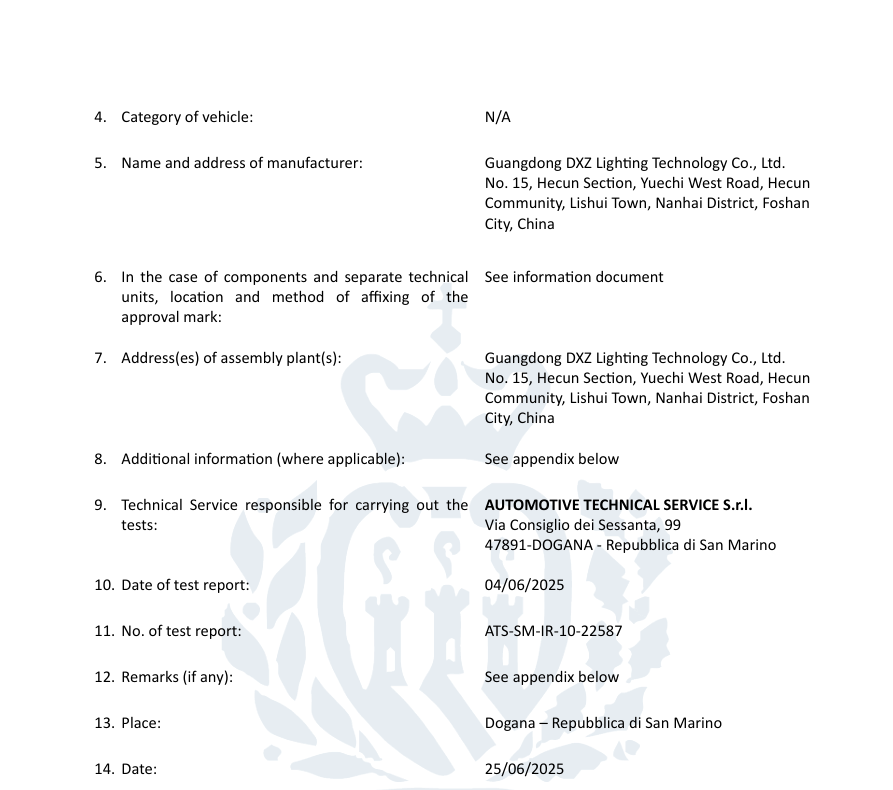
Approval formats differ: an ECE type approval in our file prints approval number E57*10R06/03*1476 for type H-F-16. It names the manufacturer and the assembly plant at the same address, and the technical service. It also prints test report ATS-SM-IR-10-22587 dated 4 June 2025 and the immunity range of 20–2000 MHz. An approval of that kind covers the type named on it and the immunity range tested, not light output, enclosure protection or service life.
Notified and approved bodies sit on registers: UK bodies are listed in UKMCAB and EU notified bodies in NANDO. The body named on a certificate can then be matched against the register it belongs to. For EMC, CISPR 25:2021 states that its limits are recommended values that a customer such as a vehicle manufacturer may agree to modify with the supplier (CISPR 25). A report that passes is not automatically a pass for your customer.
One field decides more than the rest: the suffix. If your product code is not on the list, get written confirmation that the certificate covers it before you settle price. A suffix outside the list is a different product as far as the file is concerned. E-mark approval verification covers the numbering side of the same question.
Check 4: What Conditions Sit Behind the Lumen and Beam Figures?
Read the conditions before the numbers:
- method and edition;
- ambient temperature;
- stabilisation time;
- test distance;
- sample number;
- who ran the test and who signed it.
One lumen figure without those cannot be reproduced, and two figures taken under different conditions cannot be compared.
The method named on the report tells you which procedure the laboratory followed. The current editions are ANSI/IES LM-79-24 for electrical and photometric measurement and LM-80-21 for lumen maintenance (LM-79-24, LM-80-21). A report may still cite an older edition such as LM-79-08; read the edition printed on the report, and ask why a new report would use it.
Temperature and settling belong to the result: DOE’s restatement of LM-79-2008 puts photometric measurements at 25 °C ± 1 °C, with the temperature sensor no more than one metre from the lamp, at lamp height and shielded from direct optical radiation. A report that omits ambient temperature has not described its own test.
Wattage is often quoted without its condition: ask whether the number is a cold-start or a warmed-up reading, at what voltage it was taken, and how long the lamp had been running. Then check the voltage itself. Ask the supplier quoting 12V work lights to state the voltage behind the reading, and put the same question to the supplier quoting 24V lights for a truck fleet.
Each record in a reliability dossier for one model carries a report number, a sample number, an equipment ID, the test conditions and the pass criteria. The twelve records for that model use the same form. A folder of PDFs in mixed layouts is a pile of documents, not a dossier.
Our lab record for 57C-F48F gives 1,774 lm at 13.2 V, 24.6 W and 1.87 A, with report numbers DXZ-57CF48F-02-20261104-02 and DXZ-57CF48F-09-20261104-09. The figure belongs to that model and that test, not to the series.
Who ran the test weighs as much as what it says. ISO/IEC 17025 sets the requirements for the competence, impartiality and consistent operation of testing and calibration laboratories. Accreditation bodies use it as the basis for accreditation, which is why the scope matters (ISO/IEC 17025).
Beam type has to match the file: a factory that builds combo-beam work lights normally describes two distributions in one housing, so the IES file should show the combined pattern rather than one of the two lobes.
Where the sheet and the file disagree, treat the mismatch as the finding. A supplier offering flood optics may quote a wide angle and ship a file drawn at a narrower one, and the buyer discovers it at night on a machine.
Ask for the IES or LDT file and read it against the specification sheet. The file, the report and the catalogue have to describe the same model at the same voltage. Two pages show how the distributions behave: beam angle and current worked examples and spot, flood and combo beams.
Check 5: Can You Trace the Parts Inside a Custom LED Work Light?
Yes, but only if someone will name the parts and show an incoming-inspection record for them. A price and a beam photo do not identify what sits inside the housing.
Start with a redacted BOM fragment that names:
- the LED brand, model and bin code;
- the driver;
- the connector;
- one sample incoming-inspection record for the LED reel.
Redaction is normal and expected; you are checking that the parts are specified, not asking for a supplier list.
Inside a custom LED work light, three parts decide most failures: the LED, the driver and the connector. Usually only one of them is written down. Look for a bin code and a substitution rule: a package size tells you the footprint, not the brightness or colour bin you will receive in month six.
Traceability matters most when the second order arrives. When a bin changes between batches and nobody records it, colour and output drift, and the bin code is the field that would have caught it. Two suppliers can quote the same wattage from different bins, and the buyer sees the difference only when the second container sits beside the first.
Where no BOM can be produced, put three clauses in the contract instead: locked part numbers, written approval before any substitution, and re-approval of samples after every substitution. Put those three clauses in the order; they outlive the sales conversation.
At sample stage, open one unit: the chip marking and the driver board label are what you compare against the BOM fragment a year later.
Check 6: Is the LED Work Light Factory Line Actually Running?
Two questions, answered separately: is the equipment in that building, and which standard was each test run to. Both are settled by matching identifiers.
Ask for the equipment list first, with the calibration body, certificate number and expiry date for each item. Then match the equipment IDs printed on the test reports against that list. A report naming an oven or an integrating sphere that the list does not contain is a report about another building. Cross-check one ID across two reports: the same oven carrying two serial numbers is a question worth asking.
Next is the standard field. IEC 60529 classifies and tests the degrees of protection provided by enclosures, so the standard named on a report fixes what the digits were tested to (IEC 60529). IP ratings for vehicle lights sets out what each position of the code covers.
ISO 20653 covers the IP code for electrical equipment in road vehicles and is a separate document. Ask the supplier that tests water ingress which of the two the report was run to. A rating tested to one should not be read as a rating to the other.
A vibration report needs four parameters before it means anything:
- frequency range;
- amplitude;
- direction;
- duration.
Without the amplitude the test cannot be repeated, and a frequency range alone says very little about mounting fatigue on a bracket that sees a loader’s daily cycle.
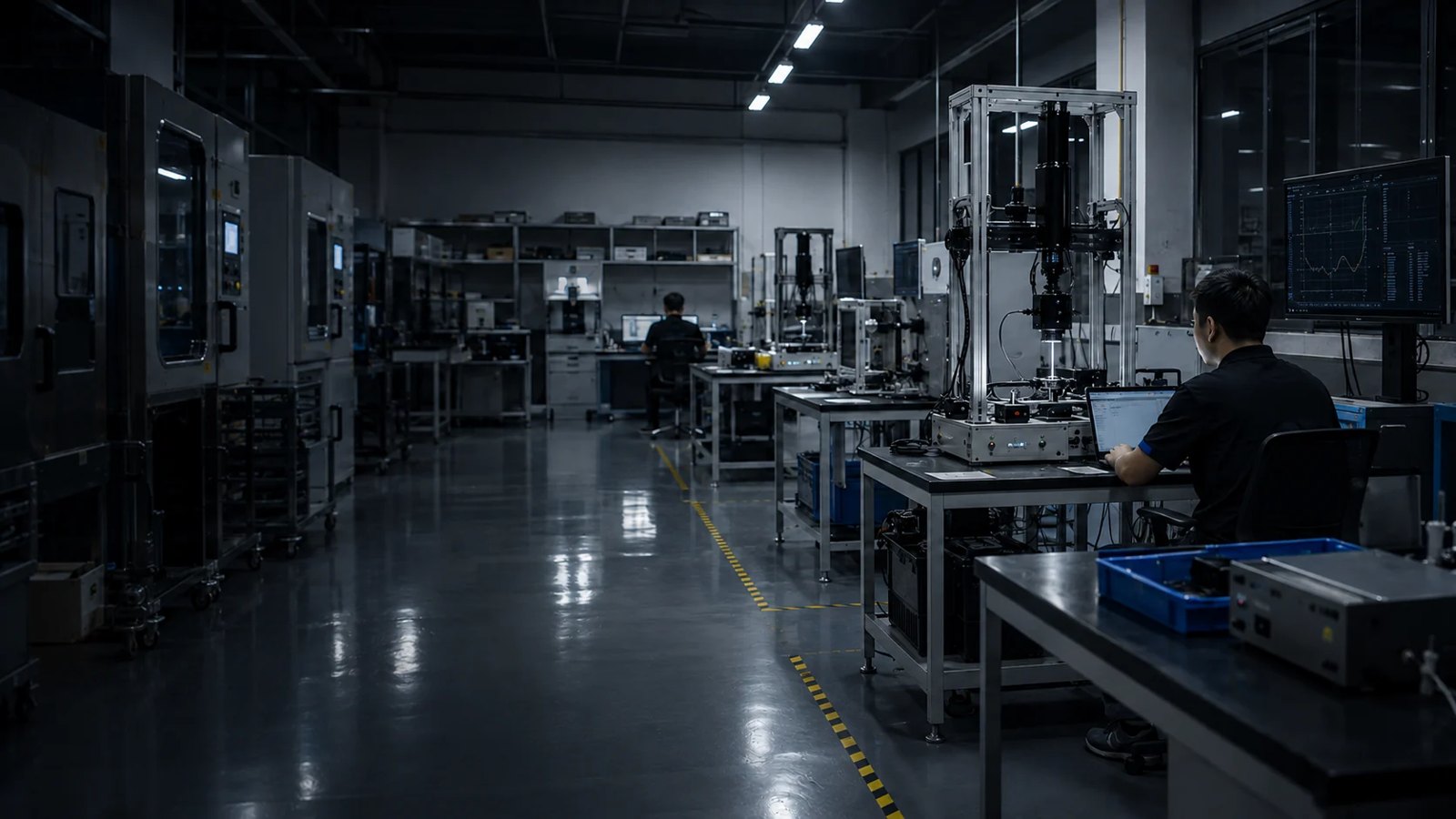
A visit to the LED work light factory answers the first question faster than any document. Three things are worth the walk: the ageing rack with lamps actually powered, the most recent water test record, and the calibration label on the photometric equipment. If travel is not possible, ask for a walk-through video of the same three items and the equipment nameplate, shot in one take. Electrical installation belongs to a different page, wiring, fuse and relay checks.
Check 7: What Do the Outgoing Records Say About the Next Batch?
They say something only if they carry batch numbers you can tie to your shipment and a reject column you can read. A pass rate describes the batch that was inspected, not the one you are waiting for.
Start with three records:
- the AQL value;
- the sampling plan;
- three months of outgoing inspection records.
Then check that the batch numbers on those records match the ones on your shipping documents. Read the reject column rather than the pass rate: a batch record is useful when it shows the lot size, how many units were inspected, what failed, and what was done about it.
A 100 % outgoing inspection sorts good units from bad ones. It does not produce the batch-to-batch measurement series you need to judge consistency. That series is what shows a slow drift in colour or output before it becomes a return.
The sampling standard carries a date. ISO 2859-1:1999, the lot-by-lot sampling standard built on AQL, was withdrawn on 22 January 2026 and replaced by ISO 2859-1:2026, so ask which edition the sampling plan follows.
Then ask for the same measurement on consecutive batches of your model: colour point, output or current draw. Read the spread rather than the average. Where the series does not exist, put a batch-limit clause in the order and let the shipping documents carry the batch number. A supplier who tracks batches can produce the series; one who does not will send a certificate of conformity, which describes a shipment rather than the variation behind it.
Check 8: What Exactly Are You Approving — a Sample or a Specification?
A sample, unless you also sign the specification and the change clause that hold production to it.
To hold a sample approval to production you need three things in writing:
- a signed golden sample with its date and BOM or firmware version;
- a specification with tolerances and pass-fail methods;
- a change-notification clause.
A sample alone is a unit someone liked, not a specification.
Records tell you who approved what. Look for an approval signature and date, not only the tester’s name; a record that stops at tested-by tells you nobody else signed it off.
Sample approval and production approval answer different questions. A certificate based on one sample does not describe how the line is controlled, and a line without a specification can pass the sample and still ship something else.
Measurement correlation deserves its own line in the specification: agree that the sample and the production units will be measured the same way on the same equipment. Two methods make a pass and a fail indistinguishable.
UK guidance expects economic operators to be sure products comply each time an individual product is placed on the market, and to take account of changes in the product’s design characteristics, which is the argument for a written change-notification clause. For private label LED work lights the clause should also name the silkscreen, the packaging version and the connector, because those three travel without a drawing.
| Field | What to record | Why |
|---|---|---|
| Type designation and approval number | Type designation and the approval/report numbers, copied from the documents | Identifiers to copy into the record; they tie the unit in your hand to the file |
| Golden sample and date | Sealed unit photo, sealing date, signature | An undated sample ties to no production period |
| BOM or firmware version | The version current at approval | Later substitutions stay invisible |
| Specification tolerances | Each parameter with tolerance and judging method | A tolerance without a method is an opinion |
| Measurement correlation | Same equipment and method for both | Two methods hide pass from fail |
| Change-notification clause | The clause in your order that governs changes | An unreferenced clause is unenforceable |
| Approval signature and date | Who approved, not only who tested | It names who is answerable |
Copy the first row from the approval document and the test report, not from the carton. Those identifiers tie the sample to a file; they do not show that the unit in the box was tested. Fill the record at sample stage, not after the first container. A record completed later describes what someone remembers, and the identifiers are the part that cannot be reconstructed.
In our file, for example, the approval number E57*10R06/03*1476 and report ATS-SM-IR-10-22587 are the identifiers; the table stays generic because your documents will carry different numbers.
Check 9: What Is Still Enforceable After the Money Moves?
What survives is written: the clauses you signed, the spare-part commitment, and whether anyone will show you a failure analysis.
Warranty terms should arrive as a document:
- what is covered;
- what is excluded;
- who pays freight and duty on a return;
- how long a claim may take from notification to replacement.
A warranty period on its own tells you little about whether a claim gets settled, because the exclusions and the freight question decide that.
One redacted failure analysis is worth more than a testimonial. It shows how the supplier investigates a failure rather than how it answers a complaint. The form matters more than the case: failure mode, batch, root cause and countermeasure is a process.
Ask for the spare-part commitment in years and for two customers in your market you may contact. Whether the supplier agrees to either request is itself information, and a refusal tells you more than a vague yes.
Put the parts that can be tested into the order: warranty scope, exclusions, freight ownership, and the batch clause from check 7. Payment structure carries risk better than a promise does.
If you want the right to inspect during the contract, write the audit clause and the notice period into the order, so the right does not depend on goodwill.
Assume a model is discontinued two years after you buy it and the replacement comes from a later build. The machine ends up with old and new units side by side, and the operator is the one who notices.
Running Nine Checks on a Heavy Duty LED Work Light Manufacturer
Split the nine by how you obtain the evidence. Five close at a desk, two need the plant or a video walk, and two belong in the sample and the contract.
- Desk, checks 1 to 5. Entity documents, quality certificate, product approval, test reports and the parts list. Each is a file the supplier either has or does not have.
- Plant or video, checks 6 and 7. Equipment against its calibration list, and three months of outgoing records read next to the line that produced them.
- Sample and signature, checks 8 and 9. The golden sample, the specification, the change clause and the warranty text.
Which layer applies depends on whether you can obtain the original record remotely. A heavy-duty factory keeps the same nine documents as any other plant. What changes is the vibration and mounting evidence under check 6, and the batch series under check 7, because a fleet order is large enough to expose drift.
Run the desk layer before you book travel, because a site visit answers fewer questions when the documents have already been read.
Write the site visits and the inspection address into the contract at the same time. An inspection right that nobody wrote down is a favour. Keep the desk layer in one folder, because it becomes the evidence pack you reopen when the second order arrives.
Questions Buyers Ask Before the First Order
Four questions come up before a first order, and each one changes which checks you make contractual.
- Can a third-party factory audit replace these nine checks? No. An audit samples a management system on the days it visits; it does not tell you whether your suffix appears on a model list or which edition a sampling plan follows. Use it as one input, and keep the nine documents as the record you own.
- Can we work with a supplier that has no plant of its own? Yes, if the entity chain is written down. A reseller can carry the order, and the certificate holder, the invoicing entity and the plant address still have to be identified, with the declaration in check 1 coming from the entity that signs the contract.
- Should a factory with no third-party test reports be ruled out? No. In-house records show what was tested and under which conditions; independence is a separate question, and only an accredited third party answers it. What you cannot accept is a figure with no test behind it.
- Can a small trial order skip some checks? A trial order lowers the batch risk, not the document risk. Checks 3, 8 and 9 cost nothing to run at any volume and decide whether a repeat order is possible; the two that scale with volume are the plant visit and the batch series.
Answer these before you ask for a sample, because each answer decides which of the nine you make contractual and which stay a document request. A trial order that skips them is a smaller order with the same unknowns.
Send Your Market, Your Voltage and Your Model
Send four things: your target market, your machine and its voltage, the model or use you have in mind, and your own checklist if you have one. Name the market as US, UK, EU or elsewhere, and the voltage as 12V, 24V or other.
In return you get the specification sheet, the photometric file, the test reports and the certificate coverage for that model, plus a sample and a quotation. The documents arrive as a PDF pack by email or through the form on this site, and they cover the model you name rather than a general catalogue.