A work light beam pattern decides what the operator sees and what everyone else has to look past. This guide shows the three distribution shapes, the sections that carry them, and how DXZ builds and records them.
We build work lights in three distribution shapes: symmetric, asymmetric and cut-off. Each shape spends the same lumen budget differently by angle. Customers send us a mounting height and a target distance, and we return the sections that fit that task. The sections come from our own goniophotometer runs on the tested sample.
| Shape | Section that describes it | Light above the horizon | Typical task |
|---|---|---|---|
| Symmetric | One C-plane section | Follows the cone | Open bay, high mount |
| Asymmetric | Vertical and horizontal sections | Set by the narrow vertical angle | Aisle, conveyor, machine edge |
| Cut-off | Upper half of the vertical section | Suppressed | Shared aisle with drivers |
Pick the row that matches the task, then read that section in the model file we send.
Contents
- Three shapes at a glance
- Symmetric beams
- Asymmetric beams
- Cut-off beams
- The photometric file
- One coverage calculation
- How a model record is held
- Pick a shape for your area
- Where the words come from
- What a label leaves out
- Write the RFQ
- Check the supplier file
- Lead time, warranty and OEM
- When one shape fails
- FAQ
- Send your geometry
The list links to every section. The three shape sections come first, then the file checks, then the commercial terms. Each section points to the page or model file that backs it, and the FAQ collects the five questions buyers raise most often.
Symmetric Beams: One Section Is Enough
A symmetric beam gives the same cone in every plane, so one C-plane section describes it. We machine a single reflector profile for these optics, which keeps the vertical and horizontal outlines equal.
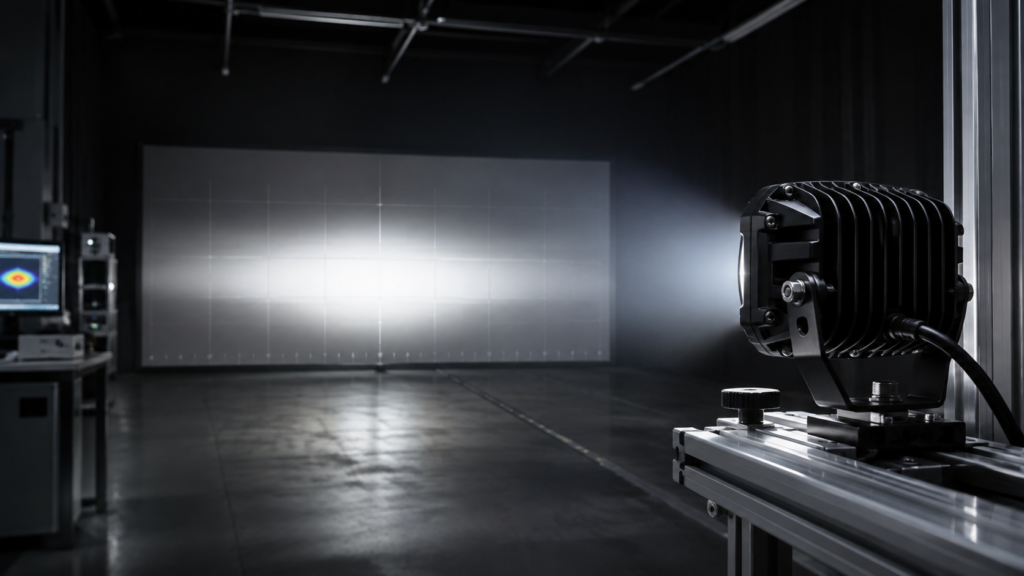
Our GO-HD reports record the beam on a road-facing plane at a fixed 1.000 m mount height. For a symmetric model the vertical and horizontal widths come out equal within the recorded scan window. The diagram below shows that match, and the unit guide explains the candela and lux readings in the report.

We test every symmetric model the same way: mount at 1.000 m, scan the road-facing window, then record peak illuminance and the 10 m value. The pattern repeats across the series, so a customer comparing two symmetric models is comparing the same protocol at two outputs.
This shape suits an open bay with a high mount, where the circle of light can spread without hitting a wall.
Asymmetric Beams: Read Two Sections
An asymmetric beam spreads wider across the task than it does upward, so the vertical and horizontal sections differ. We build these with a horizontal spread that is wider than the vertical, and some models carry the bright core off to one side. Our lab records both sections and states the horizontal and vertical angles on the report. When a customer asks for an aisle lamp, we pull the two sections and check that the horizontal angle covers the aisle width at their mounting height before we quote. The off-road light test records show the same per-model report format.

The narrow vertical angle is the part that matters for cab glass and mirrors. We set it against the eye heights the customer gives us, then confirm the horizontal width covers the task. Both angles go on the quotation so the configuration can be re-ordered without re-measuring.
An aisle, a conveyor or a machine edge is where this shape earns its keep.
Cut-off Beams: Check the Upper Edge
Fit a cut-off lamp where the upper sightlines carry people.
A cut-off beam holds back light above a chosen angle, and that edge appears as a steep drop in the vertical section. We build these for shared aisles, where drivers and pedestrians sit in the upper sightlines.
We run the vertical section first, find the angle where the candela curve drops away, and record that angle on the model report. The cut-off angle then sets where the upper boundary lands on the floor at a given mounting height, which is the number we quote back.

The three checks we run on a cut-off model are the steep drop, the recorded angle, and the dark zone at the eye heights the customer supplies. If the third check fails at their mounting height, we change the angle before we ship rather than quoting a different lamp.
Where a customer needs the eye-level arithmetic, the glare geometry in warehouse aisles page works through it from measured records.
What to Read in a Photometric File?
Check the four fields before you compare two models.
An IES LM-63 file carries intensity by angle, and four fields answer the shape question without reading the whole array. We run the angular scan for each model, then export the four fields into the report that travels with the file.
| Field | Where it sits | What we record |
|---|---|---|
| Candela table | The intensity array | Peak value and the half-peak angle |
| C-plane and gamma angles | Header and axis labels | The planes our scan covered |
| Vertical section | One slice of the table | The upper drop and the cut-off angle |
| Horizontal section | Another slice | Width and any core offset |
Our scans are the source of those four fields, and every model report carries the same four rows.
Our GO-HD reports cover a road-facing window: vertical from 10 degrees below to 5 degrees above, horizontal 30 degrees each way. That window is stated on every report, and it is narrower than a full-sphere distribution test. A partial scan with a stated window describes the beam inside that window. We print the window on the report so the file stays a scoped road-facing scan rather than a full-sphere IES or LM-79 test. Where a report cites LM-79, the edition printed on it is the one to read; the current edition is ANSI/IES LM-79-24.
The goniophotometer data page explains the scan and shows how to read the equal-illuminance map. The 1 lux contour marks the extent of the measured field under that geometry.
One Coverage Calculation
Use the beam angle to match the aisle width. Coverage follows W = 2 x d x tan(angle / 2), where d is the throw and angle is the measured half-peak angle.
Problem. A 3 m aisle at an 8 m throw needs the lit width to land on the aisle surface.
What we do. We take the measured horizontal section, read its half-peak angle and run the sum at the customer's distance.
Judgement. The 60 degree beam exceeds the aisle width. The 20 degree beam falls short of it. A 30 degree horizontal angle sits within the aisle with a small overlap.
| Horizontal angle at 8 m | Coverage width | Against a 3 m aisle |
|---|---|---|
| 60 degrees | about 9.2 m | Too wide, spills onto racks |
| 30 degrees | about 4.3 m | Within the aisle, small overlap |
| 20 degrees | about 2.8 m | Too narrow, edges go dark |
Fix. We quote the model whose measured horizontal section lands between 2.8 m and 4.3 m at the customer's distance, and we put that angle on the drawing.
Buyer action. Send us the aisle width, the mounting height and the throw distance, and request the measured angle with the quotation so it can be written into the order.
We keep one sum here so the arithmetic can be checked against the table.
How We Hold Model Records
We print the report number on the file so it can be matched to the sample.
Our lab keeps one record per tested sample, and each record carries the report numbers that name that sample. We run the illuminance test, log the peak intensity and the 10 m value, then archive the report numbers with the sample suffix.

| Step | What we do | What the file shows | ||
|---|---|---|---|---|
| Intake | We log the sample suffix and the test condition | The suffix on the quote and on the report | ||
| Test | We measure peak intensity and the 10 m illuminance | The numbered report for that model | ||
| Hold | We keep the report number with the sample record | The report number on the file you receive | ||
| Send | We send the file and the report for the SKU | The sample identifier matching your SKU | ||
| Model | Beam | 1 lux reach | Peak intensity | Original reports |
| H-F-B6-Y | Spot, yellow | 91 m | 8281 cd | Peak-intensity report · Darkroom report |
| H-F-128 | Combo | 82 m | 6724 cd | Peak-intensity report · Darkroom report |
| Model | Power at 13.2 V | Flux | Ingress rating | Product page |
| H-F-B6-Y | 12.67 W, 0.96 A | 471 lm | IP65 | LED work lights range |
| H-F-128 | 28.5 W, 2.16 A | 2398 lm | IP67 | 4-inch square combo work light |
Both rows come from the original test reports. Each report names its sample, date and device. Our lab received the samples on 1 November 2026. We tested them on 4 November 2026. The room held 25 °C and 65 % humidity.
We ran the peak-intensity test on a TK2502 automotive intensity tester. We ran the darkroom test on a CT400 goniophotometer with a GO-QYHD2 detector. Both tests used 13.2 V at a 10 m distance. Both samples passed their design limits.
The spot model carries reports DXZ-HFB6Y-03-20261104-03 and DXZ-HFB6Y-05-20261104-05. The combo model carries DXZ-HF128-03-20261104-03 and DXZ-HF128-05-20261104-05. The links above open the original files.
Our goniophotometer data page holds the distribution charts behind these peaks. The off-road light test records page holds the series PDF. The repeat-test data shows a second run on one model. The OEM and ODM page holds the certificate pack.
A 4-inch flood work light carries the flood optic in another housing. The LED work lights range lists the housings these distribution shapes ship in.
Which Shape Fits Your Work Area?
Choose the narrowest shape that still covers the target width.
We match the shape to the target width and to the eye heights in the beam path, then confirm it against the two sections in the file.
| Task | Shape we start with | Why | Section we send |
|---|---|---|---|
| Open bay from a high mount | Symmetric | Even circle | One C-plane section |
| Long aisle or machine edge | Asymmetric | Wide and low | Both V and H angles |
| Shared aisle with drivers | Cut-off | Dark above the line | The cut-off angle |
We start with the narrowest shape that still covers the target, because a wider shape spends light on racks and oncoming eyes. Where a machine does all three jobs, we zone the plan: one lamp per plane, each with its own mounting height. The forklift lighting by work area page covers zone selection for warehouses and docks, and the wheel loader lighting guide covers matching the cone to the distance on loaders.
Where the Three Words Come From
Check the original wording before you treat a regulation phrase as a rule.
Vehicle lighting regulations use these words in their titles, so they reach work-light quotations through the approval vocabulary rather than through a work-light standard. United Nations approval documents name asymmetrical passing beams and symmetrical headlamps. Front fog provisions describe a wide bar with a sharp upper edge, and SAE documents use a similar cut-off vocabulary.
| Vocabulary | Where it appears | What it covers |
|---|---|---|
| Asymmetrical passing beam | UN approval documents | Road headlamp distribution |
| Symmetrical headlamp | UN approval documents | Road headlamp distribution |
| Sharp upper edge | Front fog provisions | A wide bar with a cut-off |
| Cut-off vocabulary | SAE fog lamp documents | The same edge in another system |
Those documents cover road device approval. A work light on a loader is specified through its own photometric file. The E-mark verification guide explains how an approval document is checked for a road lamp. We keep the two sets of paperwork apart: the work-light file carries the distribution data, and any approval document names the road device it covers.
When a customer needs an approval document for a market, we name the device and the country in the quotation so the document search starts from the right place.
What Does a Datasheet Label Actually Tell You?
Check the measured angles beside the family label.
A flood, spot or combo label names a beam family, and it leaves the vertical section shape open. Two flood lamps can differ above the horizon, because one carries a cut-off and the other spills upward into oncoming eyes.
We print the family name plus the measured half-peak angles on our own datasheets, so a buyer comparing two of our models has the section width in front of them. The spot, flood and combo beam patterns page covers the family vocabulary for buyers who are still choosing between families.
There is no exact conversion from total lumens to peak candela for a real lamp, so the peak in any calculation comes from the measured angular distribution. We publish the peak and the 10 m value together on the model report for that reason.
What to Write in the RFQ
Six fields let us reproduce a geometry and quote the right model the first time. We read them against the measured sections before the quotation leaves.
| Field | What we do with it | Example entry |
|---|---|---|
| Mounting height | Sets the cut-off landing point | 2.4 m |
| Target distance and plane | Sets the coverage width | 8 m, level floor |
| Aisle or task width | Picks the horizontal angle | 3 m |
| Cut-off angle, if needed | Places the dark zone | 15 degrees down |
| Observer directions | Checks the upper sightlines | Driver 1.2 m, walker 1.5 m |
| Working voltage | Matches the report group | 12 V or 24 V |
This row shows one completed enquiry. The same six fields work for any model in the range.
We answer with three items: the IES or LDT file with both sections, the numbered report for that model, and the coverage sum at the customer's geometry. The certificate coverage list goes with the quotation so procurement records match the SKU.
How to Check the Supplier File
Check the sample identifier before the order is released.
We run five checks on every file before it leaves, and a buyer can run the same five against what they receive.
| Check | What we verify | What you receive |
|---|---|---|
| Sample identifier | The report and the quote name the same suffix | The suffix printed on both |
| Test conditions | Voltage, area, aim and lamp configuration match | Those conditions on the report header |
| Angular range | The scan window is stated on the file | The window in degrees |
| Edition | The IES edition printed on the report | That edition, plus the current one noted |
| Coverage list | The model appears in the certificate list | The list with your SKU on it |
Our certificate group covers 30 LED work light SKUs, and the model has to appear in that list for the document to apply to it. The forklift light certificates page shows how a model is tied to a document.
The same five checks apply to a file a buyer receives from us, so the file and the report can be compared item by item.
Lead Time, Warranty and OEM
We quote lead time, warranty and OEM terms with the quotation.
Three questions come with almost every distribution enquiry, and they sit outside the photometric file. We answer them here so the file discussion stays about the beam.
| Question | What we offer | Where it is written |
|---|---|---|
| Lead time and shipping | Quoted with the order against the destination | Shipping and delivery |
| Warranty | 3-year warranty across the work-light range | Warranty and after-sales |
| OEM and private label | Housing marking, packaging and connector options | OEM and ODM |
These terms travel with the quotation alongside the beam file. Price, minimum order and lead time are quoted per order against the destination, so we do not print them in a technical page.
When a distribution enquiry also needs a branded housing, we quote the two together so the beam and the marking are approved in one round.
When One Shape Cannot Do It All
Use one lamp per task plane instead of one lamp for three jobs.
We zone the plan when one machine has three jobs, because one shape cannot serve three planes at once. A loader that works a bucket, reverses down an aisle and loads at a dock gets a symmetric lamp for the bucket. It also gets an asymmetric lamp down the travel path, plus a cut-off rear lamp.
We set each lamp's target plane and mounting height on a drawing, then quote a coverage sum per lamp at its own geometry. Aiming comes before replacement: a few degrees of bracket pitch often does what a new optic would be quoted for.
FAQ
Check the five questions buyers raise most often.
| Question | Short answer | Section with the detail |
|---|---|---|
| Symmetric or flood? | Different layers: allocation vs family | Symmetric beams |
| One file for an asymmetric beam? | Yes, both sections sit in one file | Asymmetric beams |
| Does a cut-off reduce glare? | It removes light above the line | Cut-off beams |
| A file per SKU? | Yes, one record per tested model | Our model records |
| Partial scan? | The window is stated on the report | The photometric file |
Is a symmetric beam the same as a flood beam?
They name different layers. Symmetric describes angular allocation; flood names a wide beam family. Our symmetric models are flood optics, and the file shows equal vertical and horizontal sections.
Can one IES file describe an asymmetric beam?
Yes, when the candela table holds both angle pairs. We record the vertical and horizontal sections in one file and state both half-peak angles on the report.
Does a cut-off beam reduce glare?
It holds back light above a set angle in the vertical section. The eye-level result depends on height, tilt and observer, and the warehouse glare guide works through that calculation.
Do I need an IES file for every SKU?
Each tested model carries its own record and its own report number. We send the file for the exact suffix on the quotation and for that sample only.
What if the report is a partial scan?
Our GO-HD window is stated on every report, and it covers a road-facing band rather than the full sphere. The window limits what the file describes, and the report says so.
Send Your Geometry
Send three distances and we return the matching model, so start with the aisle width.
Send the aisle width, the mounting height and the throw distance, and we return the measured angle and the model that lands on it. Attach the IES or LDT file you already have, or name the model and we will send the file for that SKU.
We return a calculation sheet with the vertical and horizontal sections, the coverage width at your geometry and the shape that fits the task. The numbered report and the certificate coverage list travel with it, so the engineering and procurement records match the same suffix.