Forklift Work Light Glare: How DXZ Builds Against It
What Is Glare and Why Does It Matter in Warehouse Lighting?
Glare occurs when a light source is much brighter than the surrounding area, causing eye discomfort or making objects harder to see.
In a warehouse, this often happens when forklift work lights shine directly toward drivers or pedestrians, especially in dimly lit aisles.
Brighter lights don’t always mean better visibility. If a forklift light is too intense or poorly aimed, it can make pallet labels, rack edges, and nearby workers harder to distinguish.
This happens because strong light entering the eye can reduce visual contrast, making darker objects less visible.
The key is not simply adding more light, but directing the right amount of light where it is needed without creating unnecessary glare.
Why Can a Well-Designed Forklift Light Still Cause Glare Up Close?
Even a well-designed forklift work light can cause glare at close range. This doesn’t necessarily mean the lamp is defective. Viewing distance, beam direction, and mounting position all affect how much light reaches the observer’s eyes.
As a forklift approaches, the shorter distance can increase eye-level illuminance. However, the actual glare also depends on whether the observer is looking into the main beam or a less intense part of the light distribution.
That’s why two work lights with the same lumen output can produce different glare levels.
The key takeaway: Low-glare performance depends on more than brightness. A controlled beam pattern and proper mounting help provide useful illumination while reducing unwanted light reaching drivers and pedestrians.
Try It: Move the Truck and Watch the Number Change
The simulator below runs the same model as the two charts above. Drag the distance slider: the lamp stays fixed at 2.4 m with its measured distribution, and only the truck’s position changes. Watch the off-axis angle climb and the intensity at the eye fall away as the reader drags inward.
Interactive figure. The default lamp is the reference unit; the intensity slider lets you test a weaker or stronger optic at the same mounting height.
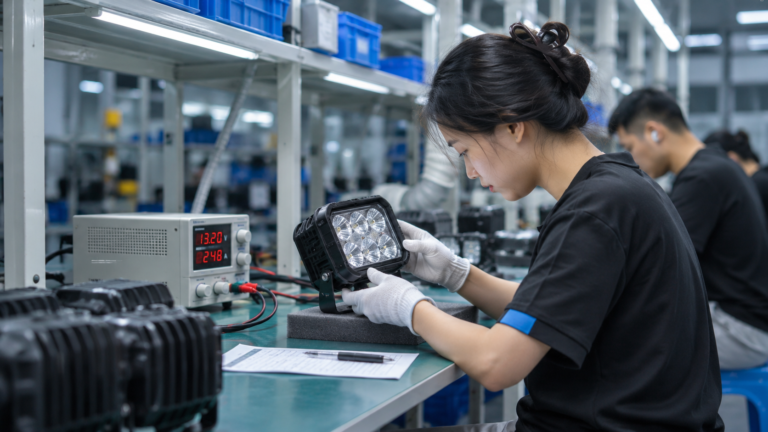
How DXZ Designs and Tests Forklift Work Lights for Glare Control
Reducing glare isn’t simply about making a light dimmer. At DXZ, we focus on directing light where it’s needed while limiting unwanted glare for forklift operators and nearby workers.
Our approach combines four practical design considerations with optical and durability testing.
| Design Feature | How It Helps Reduce Glare | How We Verify It |
|---|---|---|
| 1. Controlled Beam Pattern | Directs light toward loads and working areas while reducing excessive hotspots and stray light. | Beam distribution testing measures beam angle, peak intensity, and light spread. |
| 2. Anti-Glare Lens & Shielding | Suitable lens optics and recessed or shielded designs help limit direct light reaching workers’ eyes. | Photometric data and viewing-angle checks help evaluate unwanted light. |
| 3. Adjustable Mounting Bracket | Allows technicians to direct the beam away from operators, pedestrians, and reflective surfaces. | Vibration and mounting stability tests help assess whether the lamp maintains its position. |
| 4. Proper Light Positioning | Balances visibility of racks, pallets, and travel paths while minimizing direct and reflected glare. | On-site checks help confirm visibility from the driver’s seat and pedestrian routes. |
Additional Performance Testing
Beyond beam control, our laboratory testing evaluates other important performance factors:
- Integrating Sphere Test: Measures lumens, luminous efficacy, color temperature, and CRI.
- Electrical Performance Test: Verifies input voltage, current, and power consumption.
- Environmental Testing: Evaluates durability under specified temperature, moisture, and vibration conditions.
Why It Matters
A well-designed forklift work light should provide clear task visibility without unnecessary glare. Combining optical design, laboratory measurements, and real-world installation checks helps buyers choose lighting suited to their warehouse conditions.
What Can a Datasheet Not Tell You About Glare?
Photometric data shows how a forklift light distributes its output, but it cannot fully predict glare under actual warehouse conditions.
Mounting height, beam angle, viewing distance, and reflective surfaces all affect how much light reaches an operator’s eyes. Even the same lamp can produce different glare levels depending on its installation. The angular allocation that produces that difference is set out in symmetric, asymmetric and cut-off beam patterns.
At DXZ, we use these site-specific details alongside beam distribution data to evaluate potential glare and recommend practical solutions, such as adjusting the mounting angle, adding shielding, or selecting a more suitable beam pattern.
The goal is simple: reduce unwanted glare without compromising the visibility operators need to work safely.
What Should You Adjust First to Reduce Forklift Glare?
Start with simple adjustments before replacing equipment. The right solution depends on whether glare comes from direct light, reflections, or an unsuitable beam pattern.
1. Adjust the Light Angle
Aim the beam toward the working area rather than directly into drivers’ or pedestrians’ eyes. Check visibility from both the operator’s seat and nearby pedestrian routes.
2. Improve Shielding and Positioning
If direct glare remains, consider an anti-glare hood or an approved mounting adjustment to reduce unwanted light reaching the eyes, mirrors, or cab glass.
3. Reduce Surface Reflections
Wet floors, stretch wrap, and glossy racks can reflect light into workers’ eyes. Adjust the lighting position, reduce reflective surfaces, or improve ambient illumination where needed.
4. Consider Replacing the Work Light
If these adjustments fail to resolve the glare, the existing lamp may not suit the application. Consider upgrading to a work light with a more controlled beam pattern, appropriate brightness, and suitable anti-glare optics.
Key Takeaway: Adjust the lighting and address environmental reflections first. If glare persists, choose a better-matched work light that reduces unwanted glare without compromising safe visibility.
FAQ: Glare Questions From Facility and Fleet Teams
1. Is there a legal glare limit for forklift work lights?
OSHA does not set a specific numerical glare limit for forklift work lights. However, OSHA 1910.178(h)(2) requires auxiliary directional lighting when ambient illumination falls below 2 foot-candles (approximately 21.5 lux).
Forklift lighting should provide adequate visibility without creating excessive glare for operators or nearby workers.
2. Can a supplier certify a forklift light as glare-free?
Not based on product certification alone. Even a well-designed lamp can cause glare if improperly installed. Ask for photometric data and evaluate the beam pattern, mounting position, and actual working conditions.
3. Does a brighter forklift light always cause more glare?
No. Glare depends on beam direction, light intensity, and surrounding brightness. A properly aimed, higher-output light may provide better visibility than a lower-output lamp with poor beam control.
4. Why is forklift light glare often worse at close range?
At shorter distances, more light may reach the observer’s eyes. However, the actual glare also depends on the viewing angle and beam distribution. Proper aiming and shielding can help reduce direct glare.
5. Are lumens enough to compare forklift light glare?
No. Lumens measure total light output, not how light is distributed. Compare beam patterns, directional intensity (candela), and lens design to better evaluate potential glare.
Send Us the Numbers
A glare assessment needs five measurements from your aisle, and you already have all of them. Send the mounting height, the tilt angle, the observer’s eye height and distance, the surface conditions in the beam path, and either the current lamp’s peak intensity or its photometric file.
In return you get the eye-level calculation worked against a measured beam distribution, the tilt or shielding that brings it down, and the photometric report for the model behind the numbers. Where a model has no matching record, we will tell you that rather than substituting a figure from a similar unit.