
Motorcycle Auxiliary & Fog Lights: How Do You Mount, Wire and Aim Them Legally?
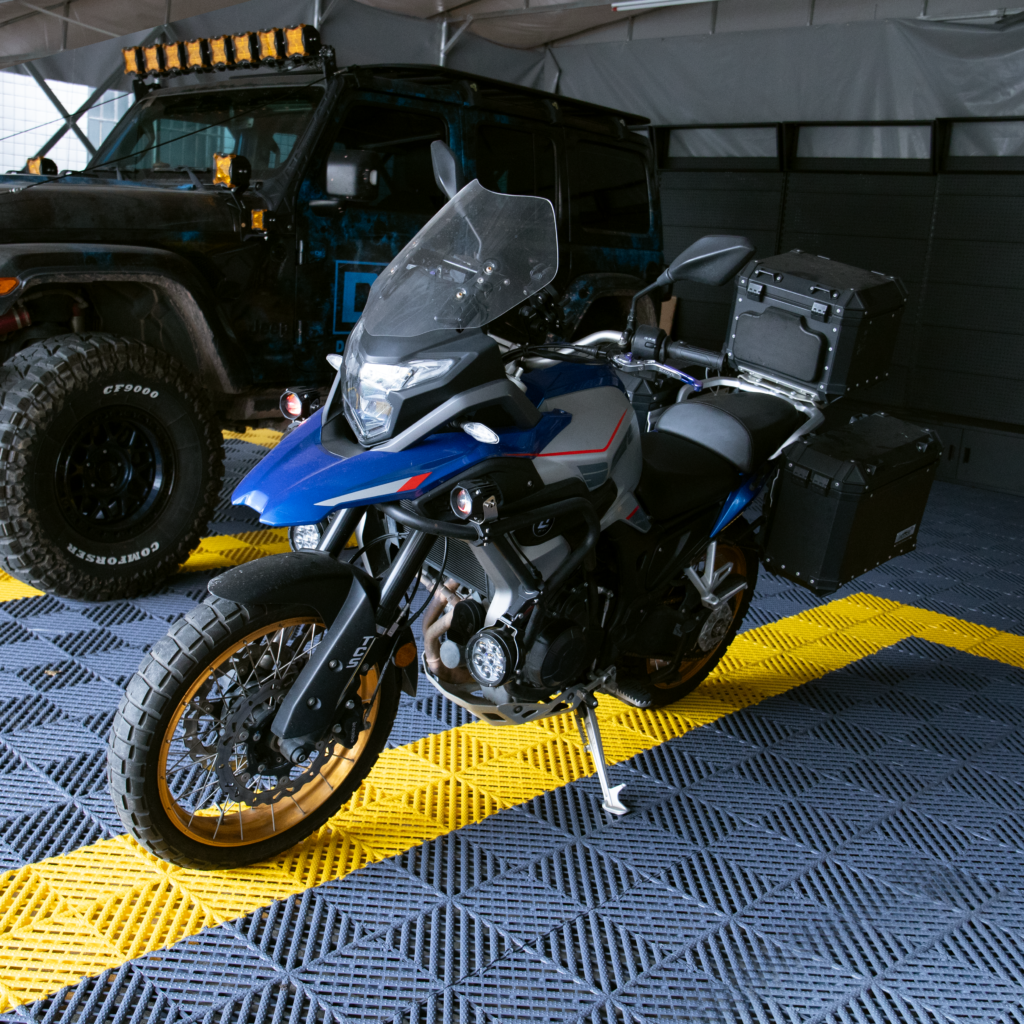
Motorcycle fog lights and auxiliary lights solve three specific problems: the near-field your headlight throws away at low speed, the wall of glare a high beam creates in fog, dust or rain, and the fact that other drivers simply do not see a single headlight at night. They are not a substitute for a compliant headlamp, and they are not a license to ride faster after dark. Get them right and you buy visibility and conspicuity; get them wrong and you buy glare, a dead battery and a conversation with a traffic officer.
The setups differ — a dirt bike on a night trail, an ADV bike on an unlit highway, a commuter who mainly wants to be seen — but three decisions determine the outcome in every case: beam pattern, mounting height and aim, and electrical headroom. This guide covers all three, then the legal framework, then what to check before you pay.
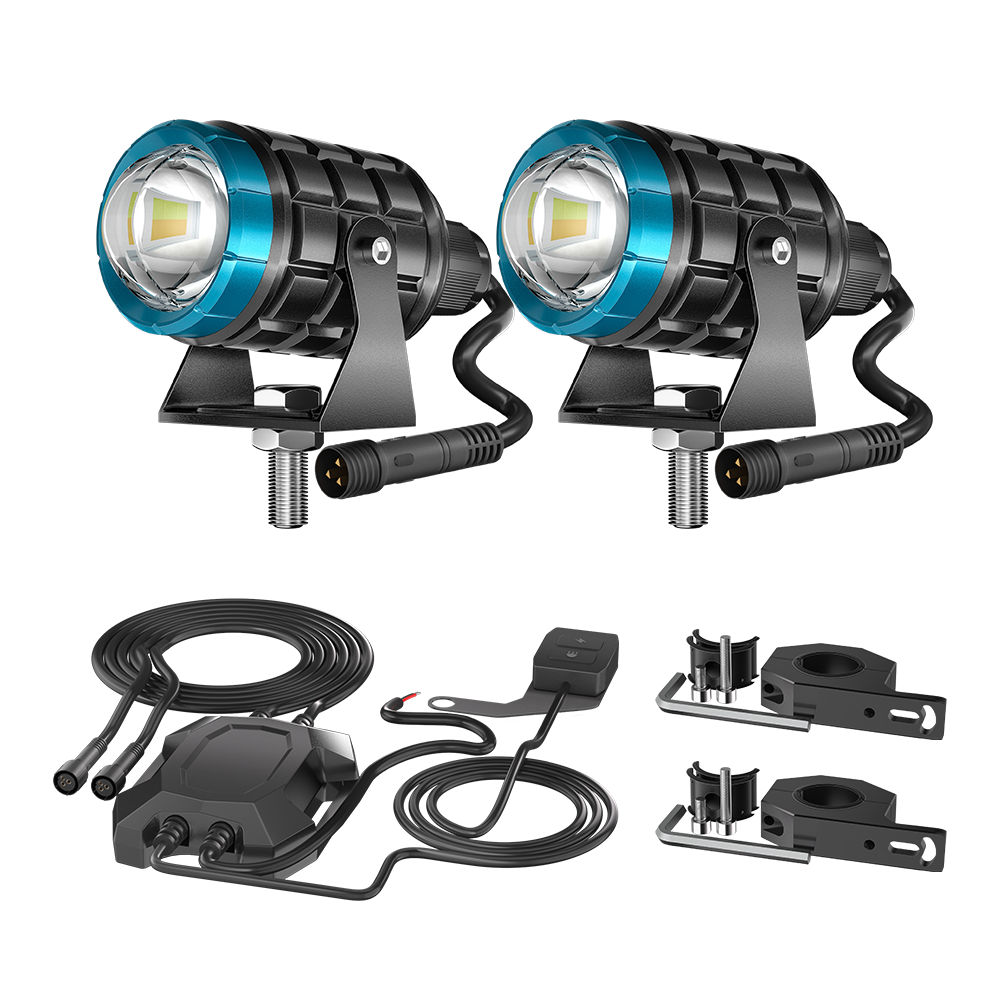
Motorcycle Auxiliary Lights: What Do They Actually Do?
A motorcycle headlamp is a compromise. Regulations push it to throw light far ahead at a specific pattern, which is why it leaves the first few meters and the road edges in near-darkness. At 60 mph you cover about 27 meters per second, so the road you have not lit yet is the road that matters most.
Motorcycle aux lights fill that gap, and they do three jobs:
- Near-field fill — lighting the shoulder and the road immediately ahead, where animals, gravel and potholes appear.
- Weather penetration — a low, wide beam aimed down cuts under fog, dust or spray instead of bouncing back into your eyes the way a high beam does.
- Conspicuity — making a narrow frontal profile recognizable as a moving vehicle to oncoming traffic, the strongest argument for daylight use.
Auxiliary lights for motorcycles are often the first real upgrade riders make — dirt bike lights included — and the pattern decides whether it was worth doing.
Motorcycle Driving Lights, Fog Lights & Auxiliary Lights: What Do the Labels Mean?
The words riders use interchangeably — auxiliary lights, aux lights, motorcycle driving lights and fog lamps — describe jobs, not products. The label on the box does not decide what a light is; beam pattern, mounting height and aim do.
| Type | Job | Typical beam | Aimed where |
|---|---|---|---|
| Headlamp | Required forward lighting | Regulated low + high | Down-range, per standard |
| Auxiliary / driving light | Supplement the high beam | Spot / pencil, narrow and long | Far ahead, high |
| Fog light | Cut under bad weather | Low, wide, sharp top cutoff | Down and short |
| Cornering light | Light the inside of the turn | Asymmetric wide | Low and outward |
| Turn signal / running light | Signaling, conspicuity | Non-illuminating | At other road users |
Motorcycle Fog Light Beam Pattern: What Does “Fog” Actually Mean?
Most listings sold as motorcycle fog lights are spot or combo lights carrying a fog-friendly label, and the same holds at the top of the market, where motorcycle driving lights are sold on throw distance alone. That matters, because putting a long pencil beam where you need a low wide wash is how riders end up staring at a glare wall in mist.
- Spot — narrow, long, concentrated. Best for distance. Worst in fog, because the tight beam concentrates energy in the droplets right in front of you.
- Flood — wide and short. Excellent for the near-field and for slow technical riding.
- Combo — a spot core with a flood skirt. The usual all-rounder for one pair.
- Fog/cutoff — deliberately low, wide, and capped with a sharp upper cutoff so light lands on the road, not in the air.
Our naming note, stated plainly. Every light in the DXZ motorcycle line is a wide-voltage, aluminum-housed Spot-pattern auxiliary unit — the range is built as auxiliary spot illumination, not as a fog-cutoff optic. In practice the range doubles as motorcycle driving lights — long, narrow throw is exactly what you want when the pair goes on with high beam. That is why we publish the beam pattern on every product page instead of calling them fog lights. If what you actually need is a cutoff fog pattern, you need a different optic, and you should say so before ordering.
Motorcycle Auxiliary Light Mounting: Where Should They Go on Your Bike?
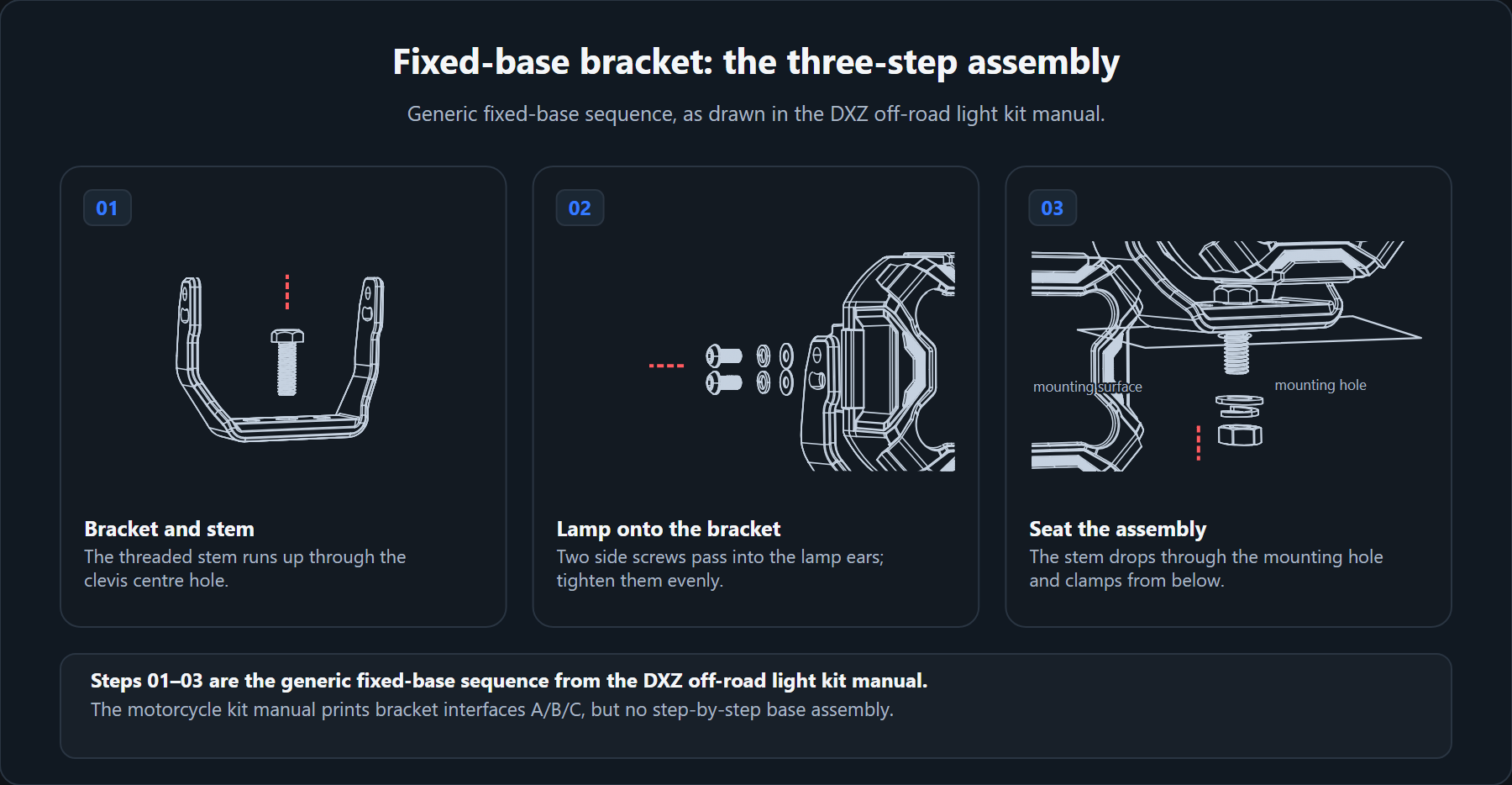
Mounting is where most installs go wrong. The useful positions are not the prettiest. Motorcycle driving lights make the aim critical, because a high, flat beam throws glare a long way. Treat this section, the aiming routine and the wiring budget that follow as one job — mount, aim, then wire.
| Position | Good for | Watch-outs |
|---|---|---|
| Fork legs / fork clamps | Low, wide near-field; turns with the wheel | Unsprung mass and vibration; check steering-arc clearance lock-to-lock |
| Engine / crash bars | Robust, high, out of the debris path | Wide spacing can wash out the center; heat and airflow |
| Handlebar / bar clamps | Easy reach, simple wiring | Bars move — aim drifts; cables must follow the steering arc |
| Front fender | Closest to the road, lowest aim | Highest vibration of all positions; unsprung |
| Windscreen / fairing | Concealed, protected | Aim is very high — the fastest route to blinding oncoming traffic |
Two rules apply everywhere, whether you fit a pair of pods or a full motorcycle light bar. Keep the light inside the steering arc so nothing snags at full lock, and route the cable along an existing loom with a service loop where the bars turn — a tight cable will eventually fail at the connector.
Motorcycle Auxiliary Light Aiming: How Do You Set It Without Glare?
Glare is the most common complaint about auxiliary lighting, and it is almost always an aiming problem rather than a brightness problem. Aim against a wall in the dark, not in daylight.
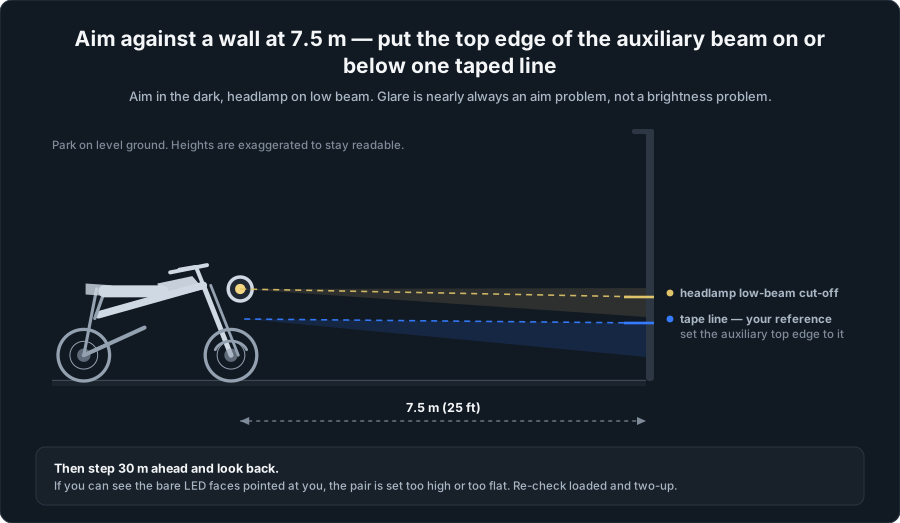
- Park on level ground about 7.5 m (25 ft) from a plain wall or garage door.
- Note where your headlamp low beam lands on the wall.
- Tape a horizontal line below that.
- Aim the auxiliary lights so the top of their beam sits on or below the tape line — closer to the bike means lower on the wall.
- Check the oncoming view: stand 30 m ahead and look back. If you can see the LED faces directly, they are set too high or too flat.
- Re-check loaded and two-up. A passenger changes the angle more than most riders expect.
Two failures are worth naming, and both hit motorcycle spotlights hardest. Bounce-back glare — light reflecting off your fender, engine or screen back into your eyes — means the light is mounted too high or aimed too flat; drop the aim before considering a smaller unit. Blinding the rider behind you is the group-riding version: a wide flood aimed flat fills the helmet of anyone following, so in convoy aim down and slightly inward.
Motorcycle Fog Lights and Auxiliary Lights: White or Amber — Which Do You Need?
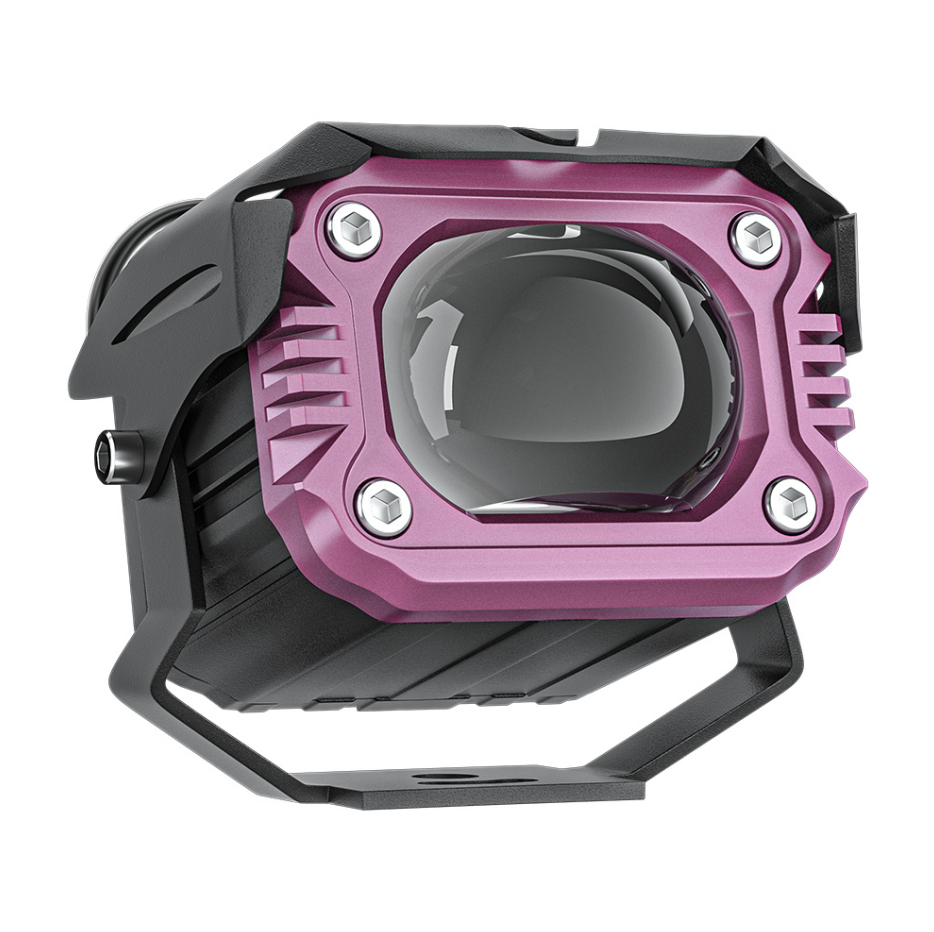
White light maximizes distance and color recognition. Amber (selective yellow) scatters less in fog, dust, rain and snow — longer wavelengths are less strongly reflected by airborne particles, so less comes back into your eyes as a glare wall. Amber is also more conspicuous in daylight.
You do not have to choose at purchase. Every model in the DXZ motorcycle line except the 2.5-inch Five-Mode kit is specified as dual-color, white + golden, so the same pair covers both roles — white for clear-night distance, amber for weather and for being seen. 2.5-Inch Five-Mode Motorcycle Light Kit lists white + yellow and adds five selectable modes.
Motorcycle Auxiliary Light Wiring: How Big a Load Can Your Bike Carry?
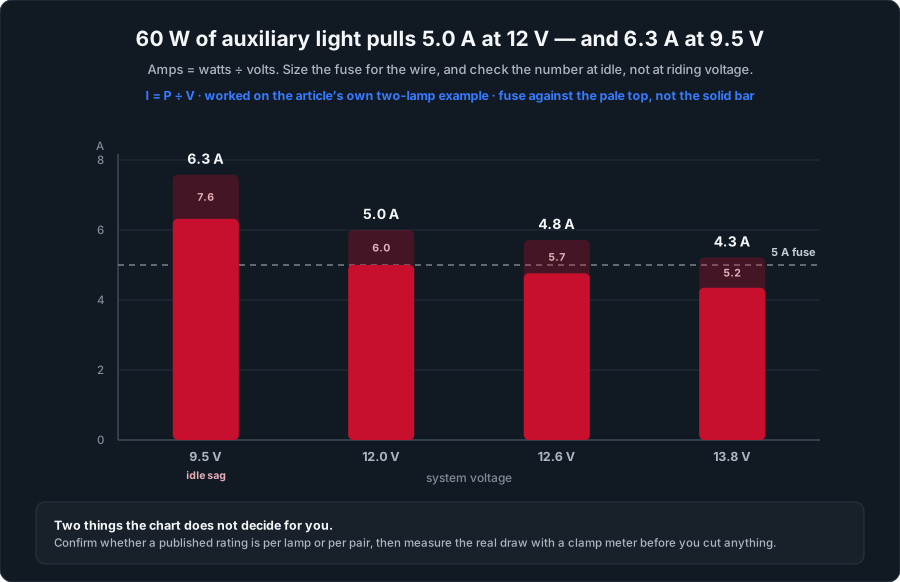
A motorcycle charging system is sized for the motorcycle. On most bikes the surplus above what the machine already consumes is modest, and a pair of lamps draws real current — do the arithmetic before you cut anything.
Amps = watts ÷ volts. A pair of motorcycle LED auxiliary lights rated at 30 W each draws about 60 W — roughly 5 A at 12 V, more at idle if system voltage sags toward 9–10 V. Add 20 % headroom, then size the fuse to protect the wire, not the lamp.
| Item | Rule | Why |
|---|---|---|
| Feed | Dedicated fused lead from battery or a switched distribution point | Never splice the headlamp circuit |
| Switching | Relay or a rated switch panel, coil on a switched source | Stops parasitic drain with the key off |
| Wiring | Match gauge to current; keep runs short | Voltage drop is what dims lamps |
| Input range | Prefer wide-voltage drivers | Keeps output stable as system voltage sags |
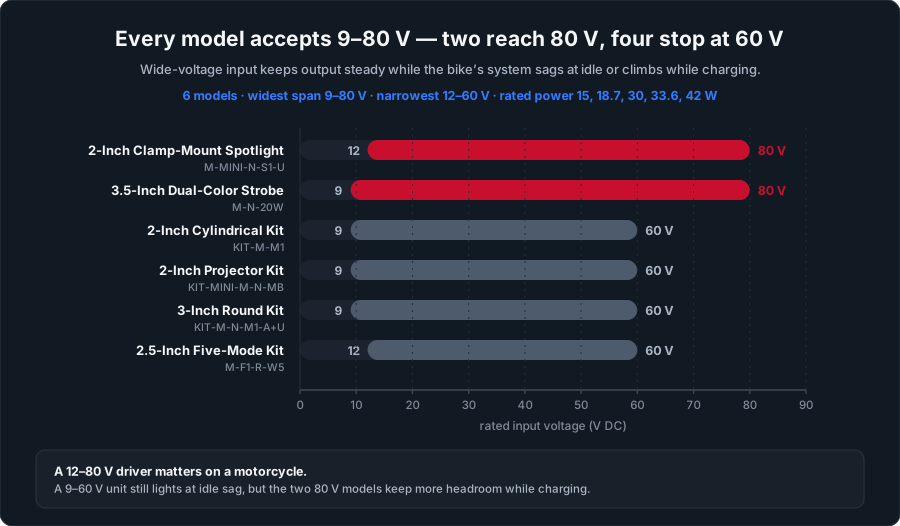
Wide-voltage input is functional on a motorcycle, not cosmetic. Verified ranges across the DXZ motorcycle LED lights run from 9–60 V to 12–80 V, covering idle sag and higher charging voltages without the output dropping as voltage moves.
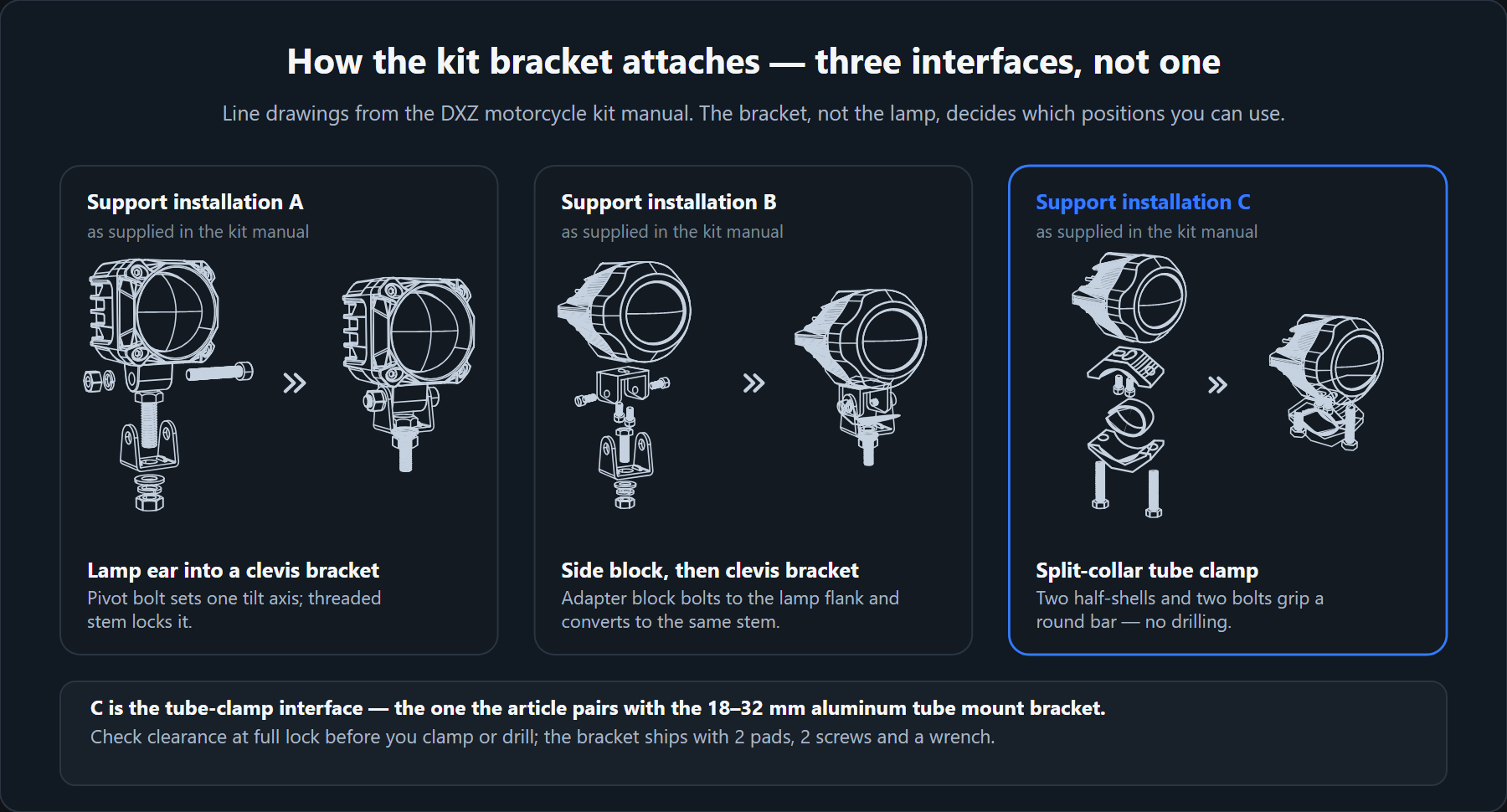
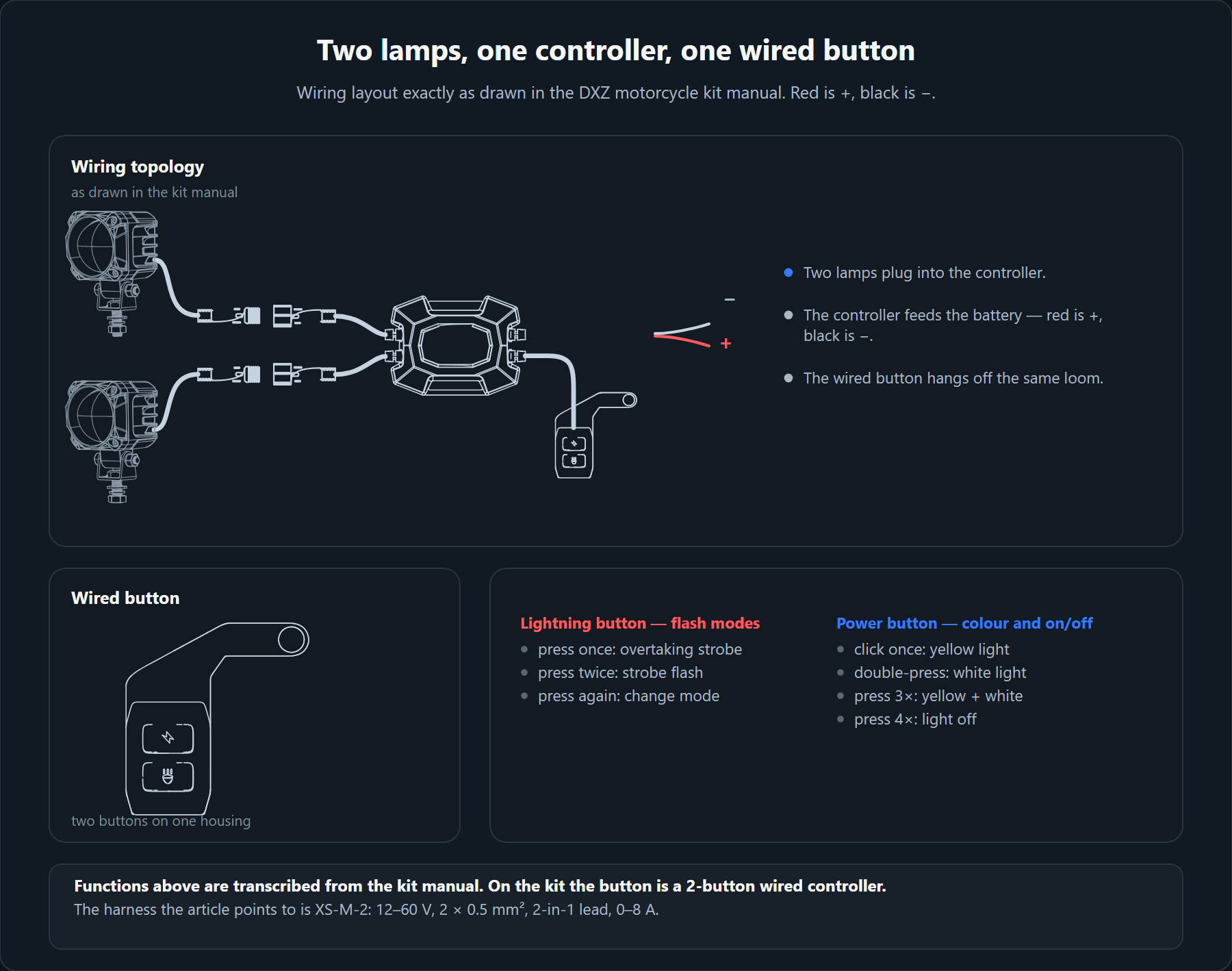
Two accessories remove most of the pain. The 18–32 mm Aluminum Tube Mount Bracket for LED Lights covers the common handlebar and crash-bar tube diameters, and the Dual-Lead 12–60 V LED Light Wiring Harness with Wired Controller gives you a fused, relayed, switchable feed for two lamps. If you want the switchgear off the bars, a 4-Gang 50 A Wireless Remote Switch Panel runs the lights from a remote instead.
Electromagnetic interference (EMI) is the complaint nobody expects. A poorly filtered driver can put noise onto the bike’s 12 V bus and wipe out FM radio, a Bluetooth intercom, or — worse — confuse a CAN-bus or an ECU input. If you get interference after fitting, suspect the driver, not the battery. Standards work in this area exists for exactly this reason (SAE J1113), and the FCC’s rules on unintentional radiators (47 CFR Part 15) are where the US obligation sits for devices that emit radio-frequency energy.
Brackets fail before lamps do. A spot lamp that loses its mount becomes a dangling hazard, so check two things: that the clamp actually grips the tube diameter you have, and that any stainless fastener threaded into an aluminum housing is protected against galvanic corrosion.
Are Motorcycle Auxiliary Lights Legal? Which Rules Apply Where You Ride?
No single rule governs auxiliary lights for motorcycles, so a one-line “is it legal” answer is always wrong. Three layers apply.
Federal (US). FMVSS 108 governs lighting equipment installed as original equipment. NHTSA sets no federal performance standard for add-on auxiliary or fog lamps, which is why makers mark them “For Off-Road Use Only” — the manufacturer saying the lamp is not certified for road use. What federal rules do constrain is forward-facing color: white or amber toward the front, with red and blue reserved for emergency vehicles.
Standards. Two SAE documents define the road-legal variants. SAE J581 covers the auxiliary high beam (white, a narrow elongated pattern, intended to be used with the high beam). SAE J583 covers the front fog lamp (white or selective yellow, with a sharp upper cutoff so the beam stays under the fog). For commercial vehicles, 49 CFR 393.24 requires auxiliary road-lighting devices to comply with those standards.
State. This is where the real constraints live, and they vary. Numbers, mounting height, color, whether a cover is required, and whether the lamps may be on at the same time as the low beam — all set at state level. California is a useful worked example because it writes the motorcycle case separately. California Vehicle Code §24402 allows not more than two auxiliary driving lamps, mounted on the front at a height of 16–42 in, designed to supplement the upper beam and not to be lit with the lower beam. California Vehicle Code §24403 allows not more than two foglamps, which may be used with but not in substitution of headlamps — and for a motorcycle the permitted mounting height is 12–40 in, as against 12–30 in for other vehicles, with a defined downward aim. Other states differ in the numbers and heights, and many require non-compliant auxiliary lamps to be covered on the road even when switched off.
Practical position: fit the lights on a switch independent of the headlamp so “off” is a real state, keep the pair aimed low, know your state’s equipment code, and where you cross borders assume the stricter rule applies. This is general information, not legal advice, reflecting sources consulted as of September 2026; verify against your own jurisdiction.
Motorcycle Auxiliary Lights: What Should You Check Before You Buy?
Brightness claims are easy to print and hard to compare: a raw lumen figure says nothing about how the light is distributed. Judge a lamp on five points instead — they hold for motorcycle aux lights and for anything sold as a kit.
- Distribution, not total output — the same output spread wide or crushed into a pencil gives completely different results on the road. Compare candela and beam maps, not headline lumens (lumens vs candela vs lux).
- Thermal design — an LED does not burn out; it loses output as it heats, so the heat path (fins, mass, housing material) sets the long-term rate of that loss.
- Consistency between units — a matched pair that ages at the same rate is worth more than two individually bright lamps (batch consistency data).
- Ingress protection — an IP rating defines a test condition, not a lifetime warranty; condensation can still appear where a light is not fully warmed (goniophotometer testing).
- Housing and lens — aluminum housing and a stable lens material age better than cheap plastics that chalk and yellow — usually the line between the best motorcycle auxiliary lights and the rest.
DXZ Motorcycle LED Light Kits: Which Auxiliary Kit Fits Your Bike?
Six representative models from the DXZ motorcycle LED lights range, chosen to cover the three mounting surfaces and both voltage bands. Specifications are quoted as published on each product page.
| Model | Form | Input voltage | Rated power |
|---|---|---|---|
| 2-Inch Clamp-Mount Motorcycle LED Spotlight | Single lamp, round-tube clamp | 12–80 V | 15 W |
| 2-Inch Cylindrical Motorcycle Auxiliary Light Kit | Paired kit, base form | 9–60 V | 30 W |
| 2-Inch Projector Motorcycle Auxiliary Light Kit | Paired projector kit, tube clamp | 9–60 V | 33.6 W |
| 3-Inch Round Motorcycle Auxiliary Light Kit | Paired round kit, tube clamp | 9–60 V | 42 W |
| 2.5-Inch Five-Mode Motorcycle Light Kit | Paired kit, five switchable modes | 12–60 V | — |
| 3.5-Inch Dual-Color Strobe Motorcycle Spotlight | Multi-mode spotlight, strobe | 9–80 V | 18.7 W |
Shared across the DXZ motorcycle LED lights range: beam pattern Spot · light color white + golden · IP67 · aluminum housing · 3 m cable on most kits. Rated power is quoted exactly as published; confirm whether a listing is per lamp or per pair, and measure real current draw, before sizing a fuse. Brackets come with most kits, but if you need a motorcycle light bracket for a specific model, that is a third-party item — DXZ supplies LED motorcycle lights and generic tube brackets, not model-specific fitments. And if you want a wide wash rather than a pair of spots, a motorcycle light bar is a different form factor from anything in this range.
Motorcycle Auxiliary Lights FAQ: What Do Riders Ask Most?
Are Motorcycle LED Auxiliary Lights Legal on the Road?
It depends on where you ride and how they are fitted. US federal rules set no performance standard for add-on motorcycle LED auxiliary lights, and forward-facing color must be white or amber. States then limit the number, mounting height and use conditions, and many require non-compliant lamps to be covered on the road — so fit them on an independent switch and check your state’s equipment code.
Can You Run Motorcycle Fog Lights With Your High Beam at Night?
That is usually the wrong combination. A fog pattern is for low-speed, bad-visibility riding with the beam aimed down; adding the high beam reintroduces the glare the fog lamp was meant to avoid. Many states also restrict which combinations may be lit together.
Motorcycle LED Light Wiring: Do You Need a Relay, or Can You Splice In?
Use a relay or a rated switch panel with a dedicated fused feed. Tapping the headlamp circuit overloads a wire sized for one lamp and is a common cause of melting connectors.
Motorcycle Auxiliary Lights: Will They Drain Your Battery or Overload the Charging System?
They can, if you add load without checking headroom. Work out amps as watts ÷ volts, add margin, and compare that against what your machine has spare. Wide-voltage drivers help, because output stays stable as system voltage sags at idle.
Motorcycle Spotlights: How Do Spot, Flood and Combo Beams Differ?
Most motorcycle spotlights are narrow and long — distance, but poor in fog. Flood is wide and short — near-field and technical riding. Combo blends both and is the usual choice for a first pair.
Motorcycle Fog Lights: Are Amber or Yellow Better Than White?
Amber scatters less in fog, dust, rain and snow, so less light comes back into your eyes, and it is more conspicuous in daylight. White still wins for distance on a clear night, which is why dual-color lamps are useful.
Motorcycle Auxiliary Light Height: How High Should They Be Mounted?
Low. Low mounting fills the near-field and reduces glare to oncoming traffic; high mounting mostly lights the road you have already passed — the miss is worse with motorcycle driving lights, which throw far and glare just as far when aimed high. Where states set a height range, it applies to road use.
Motorcycle LED Lights and Radio Interference: Why Does It Happen?
The driver’s filtering is the usual cause — noise on the 12 V bus reaching sensitive electronics. It is an electromagnetic-compatibility issue, not a power problem, and it is worth checking before purchase.
Motorcycle Auxiliary Lights: What’s the Bottom Line?
Motorcycle LED lights in auxiliary or fog form solve three real problems: the dark near-field, the glare wall of bad weather, and being hard to see. Choose the beam for the job, mount low, aim against a wall, check the load arithmetic, and keep the pair on their own switch.
DXZ builds its motorcycle LED lights around wide-voltage, aluminum-housed, dual-color spot auxiliaries, and publishes the beam pattern and input range on every product page so you can match the light to the job. If you are specifying lighting for a fleet, a dealer program or an OEM build, the same range is available for OEM & ODM projects.