Yellow Driving Lights vs. Amber Off-Road Lights: The B2B Engineering & Sourcing Guide
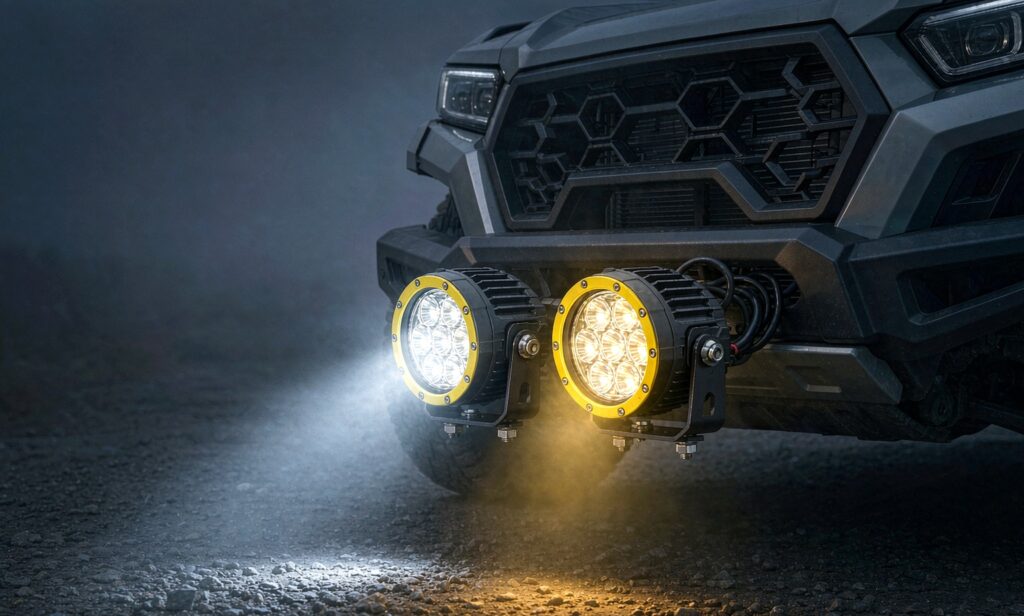
Yellow driving lights and amber off-road lights are sold as one product family but specified as three different things: a colour, a beam function and a legal category. This guide separates the three, with the colorimetry, the thermal data and the compliance rules that decide whether a container order arrives sellable or stuck at customs.
Executive Summary: Why Engineering Precision Dictates Margin in Auxiliary Lighting
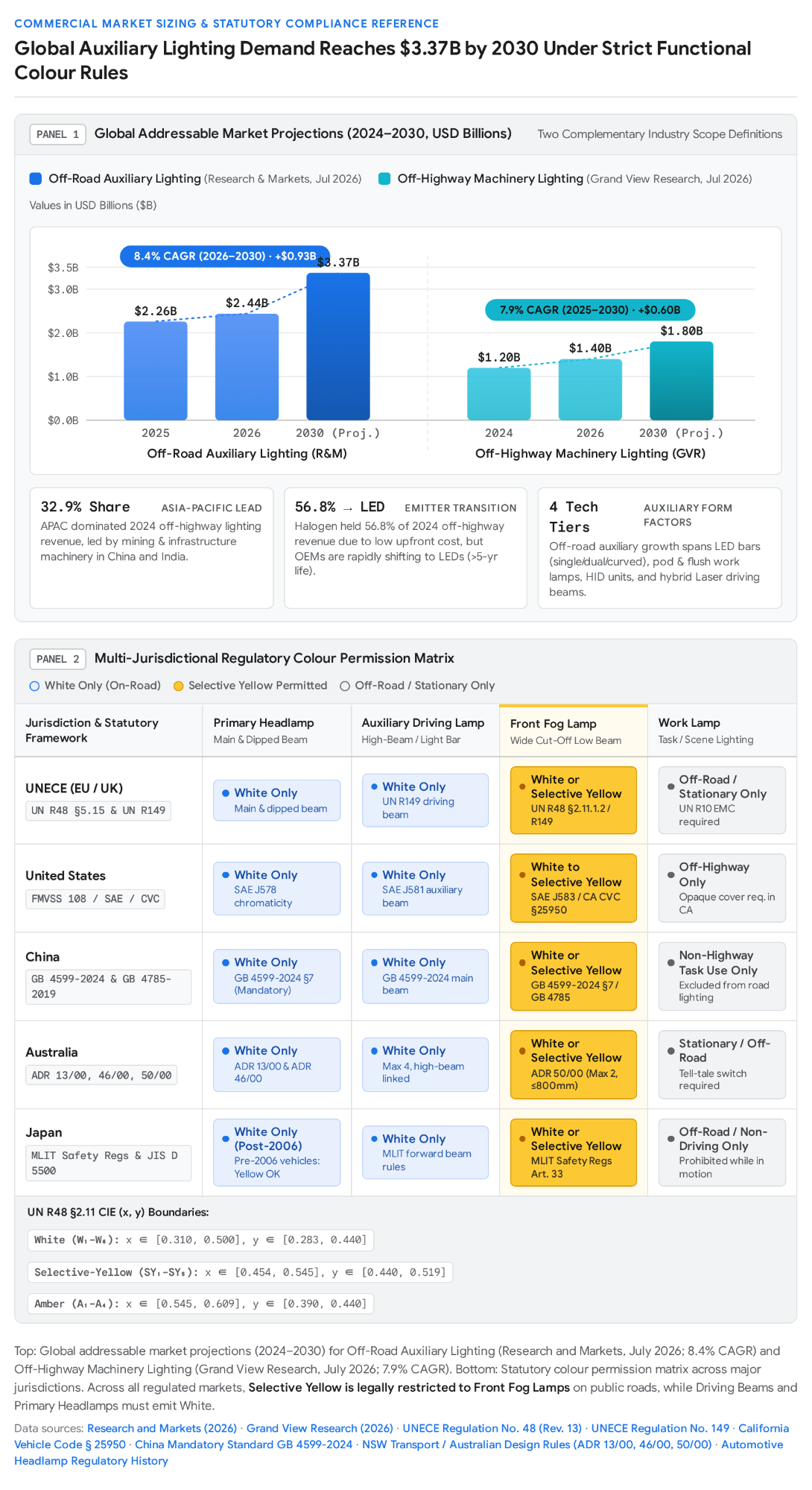
Across the global automotive aftermarket and commercial equipment supply chain, yellow driving lights and amber off road lights have transitioned from niche desert-racing accessories into high-margin core catalog lines. According to Research and Markets (2026), the dedicated global off-road auxiliary lighting market reached USD 2.44 billion in 2026 and is projected to hit USD 3.37 billion by 2030 (growing at an 8.4% CAGR), alongside a USD 1.40 billion off-highway machinery lighting sector (Grand View Research, 2026). While factory Free-on-Board (FOB) unit costs for standard auxiliary pods range from USD 14 to USD 28 per pair, turnkey retail kits in North America and Australia command USD 170 to USD 550+ — an 8× to 18× valuation multiplier captured by brands that control optical distribution, colorimetric consistency and regulatory homologation.
For B2B procurement teams, however, sourcing non-white forward lighting carries acute technical and legal traps. Commodity suppliers routinely conflate 3000K warm white, selective yellow and signalling amber, resulting in container lots that fail customs inspections, violate highway statutes or suffer 50%+ illuminance losses in the field. Worse yet, using the wrong semiconductor die architecture can cause an amber lamp to lose nearly two-thirds of its brightness within ten minutes of operation due to thermal droop.
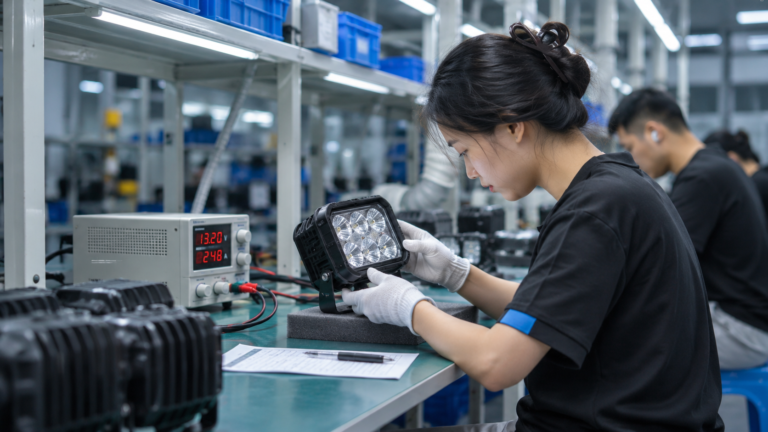
As an engineering-led automotive LED lighting manufacturer founded in 2014 with a 6,300 m² production base in Foshan, China (DXZ Lighting), DXZ has engineered this technical reference to help importers, distributors and private-label brands specify, audit and source high-performance yellow and amber auxiliary lighting systems with zero compliance ambiguity.
1. Optical Physics & Human Psychophysics: What Are Amber Lights Used For Off Road?
When retail buyers or fleet managers ask “what are amber lights used for off road?”, traditional marketing copy almost universally repeats a ninety-year-old myth: that yellow or amber wavelengths “cut through” or “penetrate” fog, rain, snow and dust physically further than white light due to Rayleigh scattering. For a B2B technical buyer or upfit engineer, separating physical optics from human visual psychophysics is essential to building an honest, high-converting product line.
1.1 Why Lorenz–Mie Scattering Rules Out “Wavelength Penetration” in Fog, Rain and Dust
In electromagnetic scattering physics, the interaction between a light beam of wavelength λ (0.38–0.78 µm for visible light) and suspended atmospheric particles of diameter d (radius r = d/2) is governed by the dimensionless size parameter x = 2πr/λ = πd/λ.
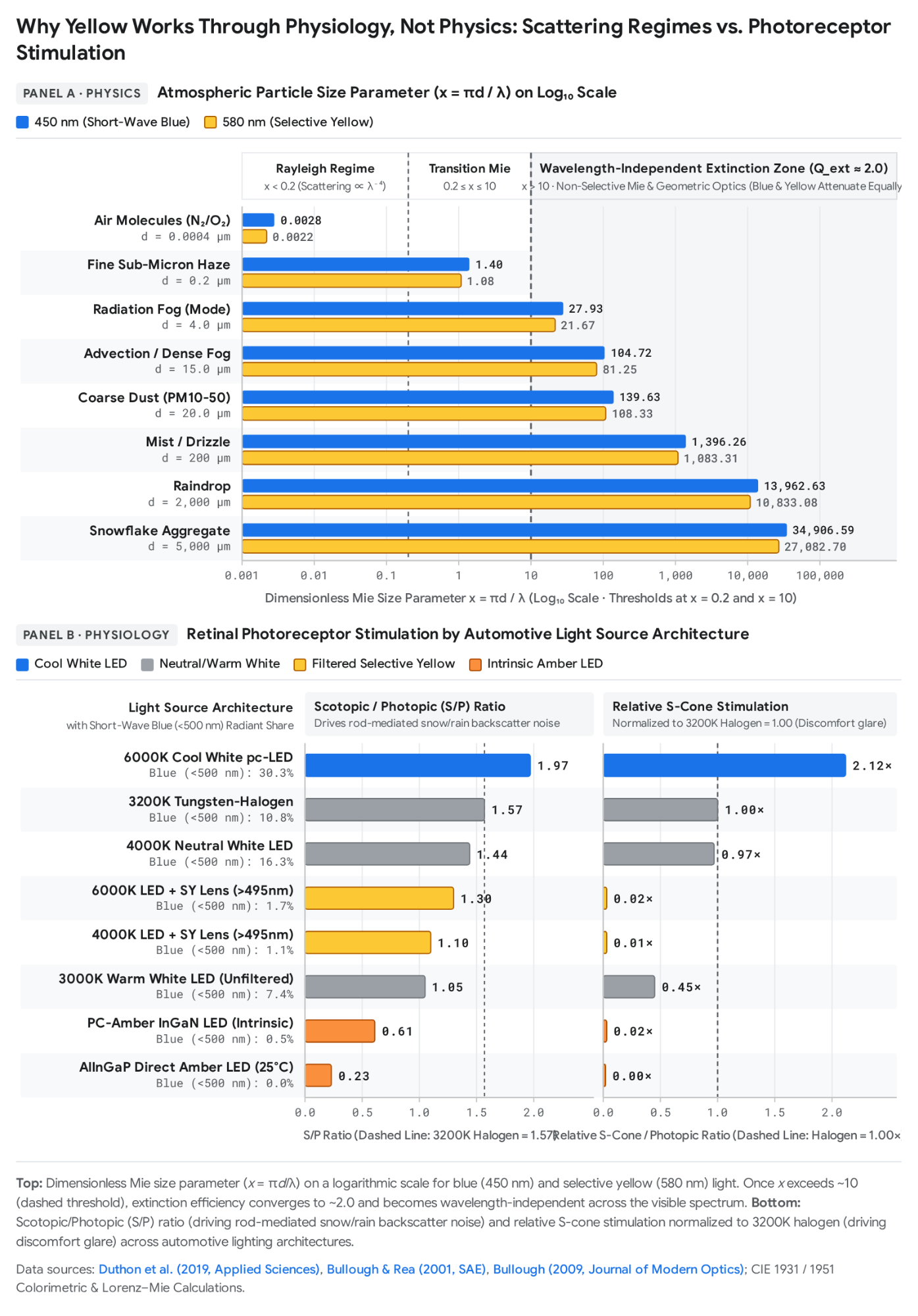
Wavelength-dependent Rayleigh scattering — where scattering intensity scales inversely with the fourth power of wavelength (Iscat ∝ λ−4), causing 450 nm blue light to scatter 2.76× more strongly than 580 nm yellow light — only occurs when particles are at least an order of magnitude smaller than the wavelength of light (x << 1, such as diatomic nitrogen and oxygen molecules at d ≈ 0.0004 µm) (Bullough & Rea, 2001).
In real-world driving and off-highway environments, suspended aerosols and hydrometeors are one to four orders of magnitude larger than visible wavelengths:
- Radiation (continental) fog: d = 1.0–10.0 µm (Mie size parameter x ≈ 21.7–27.9)
- Advection (maritime) and dense fog: d = 10.0–20.0 µm (x ≈ 81.3–104.7)
- Airborne coarse trail dust (PM10–PM50): d = 10.0–50.0 µm (x ≈ 108.3–139.6)
- Mist, drizzle and raindrops: d = 100–5,000 µm (x ≈ 1,083–13,962)
- Snowflakes (aggregates): d = 1,000–10,000 µm (x ≈ 27,082–34,906)
Once the dimensionless size parameter x exceeds ≈10 (d > 2 µm), oscillatory resonances damp out and the Lorenz–Mie extinction efficiency factor converges asymptotically to a constant Qext ≈ 2.0 across all visible wavelengths. Controlled spectroradiometric testing by Duthon, Colomb and Bernardin (2019) at the French Cerema PAVIN BP fog tunnel — recording 4,456 extinction measurements across 213 wavelengths (360–2,490 nm) at meteorological optical ranges from 15 m to 175 m — proved definitively that the atmospheric extinction coefficient k(λ) is completely flat across the entire visible spectrum (350–1,000 nm) in both radiation and advection fog. Under the Bouguer–Lambert attenuation law, yellow light and white light attenuate at the exact same physical rate.
1.2 Suppressing S/P Ratio Dynamic Visual Noise and S-Cone Discomfort Glare
If yellow off road lights and amber driving lights do not physically travel further through fog or dust, why do desert racers, snowplow operators and overland drivers universally report superior visibility when switching from cool white to yellow or amber? The answer lies in retinal photoreceptor physiology and foreground veiling luminance (Lv).
- Suppression of rod-mediated dynamic visual noise (S/P ratio). The human retina relies on foveal cones for high-acuity photopic vision (V(λ), peaking at 555 nm) and peripheral rods for night scotopic vision (V′(λ), peaking at 507 nm cyan-blue). Standard 6000K cool-white LEDs emit 30.3% of their radiant power in the <500 nm blue pump spike, yielding a scotopic-to-photopic (S/P) ratio of 1.97. When driving at night in falling snow, rain or swirling trail dust, thousands of moving foreground particles backscatter this blue-rich light into the driver’s eyes. Research at the Lighting Research Center (Bullough & Rea, 2001) demonstrated that dynamic flickering backscatter strongly excites rod photoreceptors up to mesopic and low-photopic luminances of 65 cd/m², creating “dynamic visual noise” that degrades visual tracking accuracy. Shifting the spectrum to selective yellow (S/P = 1.10) or intrinsic PC-Amber (S/P = 0.61) starves the 507 nm rod pathway of short-wavelength energy, silencing foreground snow and dust flicker.
- Elimination of extrafoveal S-cone discomfort glare. While disability glare (ocular media scatter) depends solely on photopic lux, subjective discomfort glare (measured on the 9-point De Boer scale) follows a U-shaped spectral sensitivity curve driven by short-wavelength S-cone photoreceptors peaking at ≈442 nm (Bullough, 2009; Sivak et al., 2005). Normalised to a 3200K halogen lamp (1.00×), a 6000K cool-white LED generates 2.12× the S-cone glare stimulation per lumen. Filtering or converting the beam to selective yellow or PC-Amber reduces S-cone stimulation to 0.01–0.02× (a 98–99% reduction) while eliminating longitudinal chromatic aberration (blue light focusing in front of the retina).
- Chromatic conspicuity in white-DRL traffic and dust plumes. In daytime urban traffic saturated by white Daytime Running Lights (DRLs) or multi-vehicle desert convoys obscured by silt plumes, yellow/amber forward and DRL accents create immediate chromatic contrast. Controlled visual search trials by Pinto, Cavallo and Saint-Pierre (2014) proved that a yellow front light improved far-distance vehicle detection from 39% to 54% (p < 0.05) and central detection from 71% to 90% (p < 0.05).
The clear-air boundary trade-off. Upfitters must note that in clear, dry nighttime driving at high speeds, broadband white light (4000K–6000K) remains superior for long-range peripheral hazard detection (15°–23° off-axis) and provides nearly 30% longer pedestrian colour recognition distance than narrowband yellow/amber (Gibbons et al., 2015, FHWA-HRT-15-047). That is why DXZ’s flagship driving and off-road platforms — such as the 7-inch (7R01–7R05), 9-inch (9R01–9R05) and 10-inch (10C01–10C05) LED driving lights and dual-colour pods like the PY35-1-Spot — are engineered either with switchable white and yellow main beams or a high-output white spot main beam paired with a dedicated yellow/amber DRL channel.
2. Selective Yellow vs. Amber: Spectral Wavelengths, Lumen Retention & Solid-State LED Architectures
In the B2B aftermarket, the debate over selective yellow vs amber is frequently clouded by imprecise catalog labelling. When procurement managers specify colour by Kelvin rating alone (for example, requesting “3000K yellow”), they expose their brand to compliance failures and customer returns.
2.1 Colorimetric Precision: Selective Yellow (570–590 nm) vs. Amber (590–620 nm) vs. 3000K White
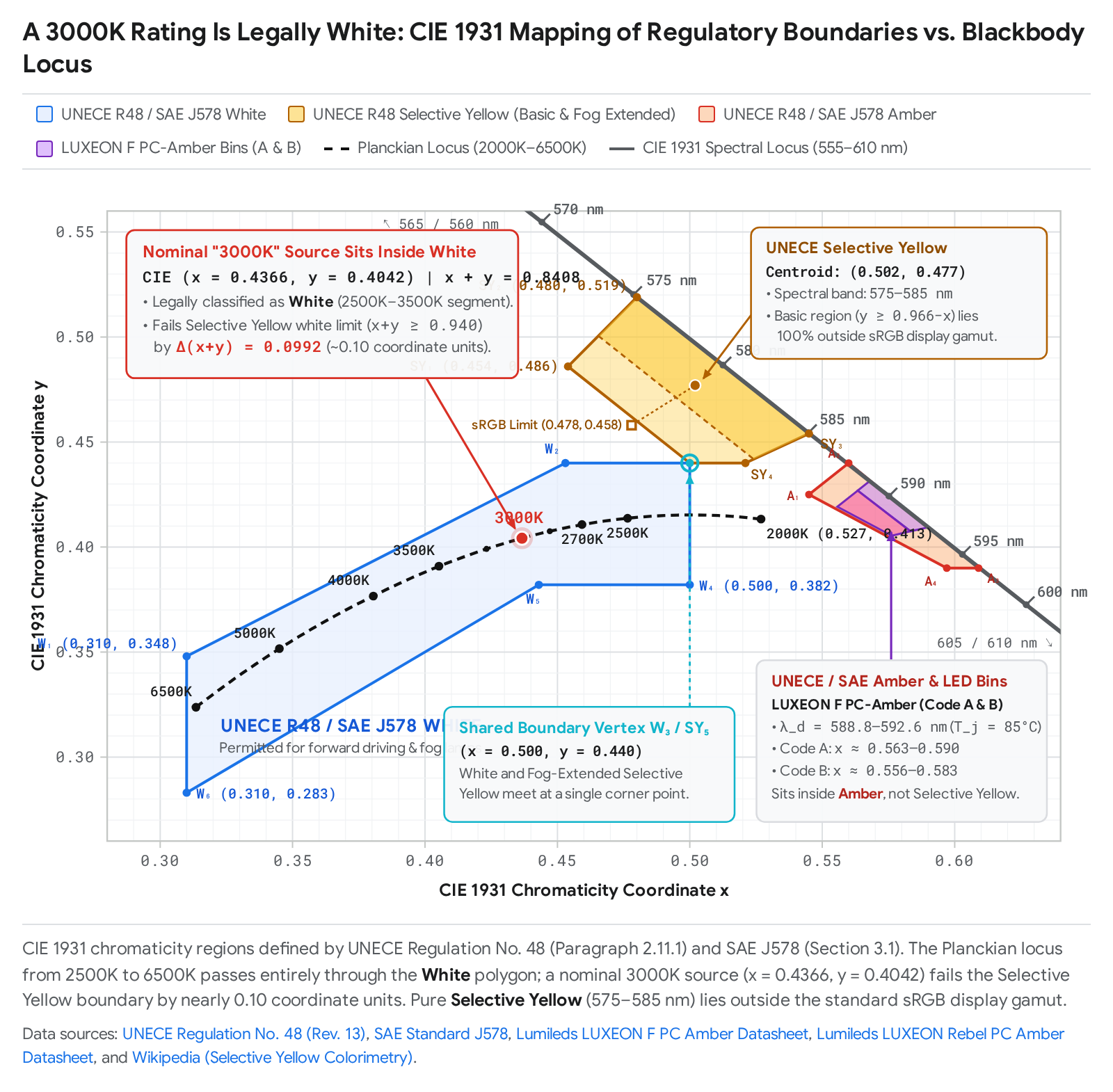
In formal automotive colorimetry governed by UNECE Regulation No. 48 (Paragraph 2.11.1) and SAE J578 (Section 3.1), colour categories are defined not by Correlated Color Temperature (CCT in Kelvin), but by closed mathematical polygons on the CIE 1931 2° Standard Observer (x, y) chromaticity diagram:
- Selective yellow (570–590 nm engineering band; statutory locus ≈575–585 nm). Under UN Regulation No. 48 (Paragraph 2.11.1.2) and UN Regulation No. 149 (consolidating UN R19 front fog lamps), selective yellow is bounded by the green limit y ≤ 1.290x − 0.100, the red limit y ≥ 0.138 + 0.580x, the yellowish-white limit y ≥ 0.440 and the white limit y ≥ 0.940 − x, requiring excitation purity pe ≥ 0.820 under SAE J578 Section 3.1.2.1. Because x + y + z = 1, the requirement x + y ≥ 0.940 restricts the blue tristimulus coordinate z to ≤ 0.060. Visually, selective yellow emits a bright lemon-gold beam that sits close to the 555 nm peak of human photopic vision, maximising road surface illuminance (lux) while completely stripping out <500 nm glare.
- Amber (590–620 nm engineering band; statutory locus ≈587.5–596.3 nm). Under UN Regulation No. 48 (Paragraph 2.11.1.3) and SAE J578 (Section 3.1.2, titled “Yellow Amber”), amber is bounded by the green limit y ≤ x − 0.120, the red limit y ≥ 0.390 and the white limit y ≥ 0.790 − 0.670x, with excitation purity reaching 97.6–99.9%. Depending on whether the emitter is an InGaN PC-Amber LED (λd ≈ 588.8–592.6 nm) or a thermally heated direct AlInGaP LED (which shifts from 590.6 nm at 25 °C to 596.2 nm+ at 85 °C, with long-wavelength tails extending to 620 nm), amber produces a rich, deep orange-gold hue. While its longer wavelength moves further down the V(λ) photopic sensitivity curve (yielding lower raw lux per watt than selective yellow), it provides maximum visual contrast against bright daylight, heavy desert silt and white-out snowdrifts.
- The 3000K warm-white trap. A pervasive B2B sourcing error is purchasing unfiltered 3000K warm-white CSP/SMD LEDs under a clear lens as a substitute for selective yellow. On the CIE 1931 diagram, a Planckian radiator at 3000K sits at (x = 0.4366, y = 0.4042), giving x + y = 0.8408 (z = 0.1592). It fails the UNECE/SAE selective-yellow white boundary (x + y ≥ 0.940) by nearly 0.10 coordinate units, retains 7.4% blue pump energy at 450 nm, and is legally classified as white across all UNECE and SAE jurisdictions.
2.2 Photometric Loss Breakdown: Why Optical Architecture Matters (6.6% vs. 50.6% Loss)
When engineering yellow driving lights or amber off road lights, the method used to generate the colour determines how much usable illuminance reaches the trail. Independent NIST-calibrated spectrometer measurements (TacomaWorld SAE J583 photometric dataset) and spectral integrations across solid-state architectures reveal a massive spread in optical efficiency:
| Optical & emitter architecture | Measured / calculated photopic loss | S/P ratio (rod noise) | Relative S-cone glare (3200K = 1.00) | Engineering & commercial assessment |
|---|---|---|---|---|
| 1. Neutral-white InGaN LED (4000K) + doped selective-yellow TIR optic | −6.6% to −9.0% (91.0–93.4% retention) | 1.10 | 0.01× | Gold standard for selective yellow: only a 1000K filtration shift is required, stripping blue glare with minimal flux penalty. |
| 2. Cool-white InGaN LED (6000K) + selective-yellow polycarbonate lens | −12.0% to −16.0% (84.0–88.0% retention) | 1.30 | 0.02× | Standard subtractive route: matches the UN R19 0.84 statutory multiplier; absorbs the large 450 nm spike as lens heat. |
| 3. Intrinsic InGaN PC-Amber LED (589–592 nm) + clear optic | 0% filter loss (110 lm/W at Tc = 85 °C) | 0.61 | 0.02× | Gold standard for true amber: nitride phosphor converts >99% of blue photons directly into broad-spectrum amber. |
| 4. Cool-white LED (6000K–7400K) + clip-on dark amber cover | −47.6% to −50.6% (49.4–52.4% retention) | ≈0.65 | 0.01× | Severe efficiency penalty: dark amber (>550 nm) blocks both the 450 nm blue peak and the 555 nm green phosphor shoulder, plus 8% Fresnel loss. |
| 5. Unfiltered 3000K warm-white LED + clear lens | 0% filter loss | 1.05 | 0.45× | Non-compliant for selective yellow: legally classified as white; retains 45% of halogen S-cone discomfort glare. |
As the photometric data confirms, snapping an aftermarket dark amber polycarbonate cover over a 6000K cool-white pod destroys 50.6% of usable illuminance (dropping output from 395.5 lx to 195.2 lx in independent testing) while creating an unsealed air gap that traps mud and abrades the primary lens. At DXZ’s in-house optical laboratory, integrating-sphere and darkroom goniophotometric tests are conducted on every SKU so B2B buyers can evaluate true thermally stabilised lumen and lux retention before committing to production.
2.3 Semiconductor Die Selection: InGaN PC-Amber vs. Direct AlInGaP Thermal Droop
For buyers sourcing dedicated amber pod lights, amber LED light pods or work lights with amber DRL and warning channels, the single most dangerous hidden defect in the supply chain is semiconductor thermal droop.
Historically, monochromatic amber LEDs were fabricated using quaternary aluminium indium gallium phosphide (direct AlInGaP) semiconductor junctions. While AlInGaP performs adequately in low-duty-cycle turn signals at 25 °C room temperature, continuous high-current operation in an enclosed off-road pod or work lamp drives LED case and junction temperatures (Tc / Tj) to 85–120 °C.
Comparative pulsed and steady-state testing reported by Lumileds at the US Department of Energy SSL R&D Workshop (Epler, 2020) at I = 350 mA between Tc = 25 °C and Tc = 85 °C exposes why direct AlInGaP is unsuitable for high-power auxiliary lighting:
- Catastrophic lumen collapse (Lm H/C = 0.36 vs. 0.87). Due to shallow quantum-well carrier confinement, direct AlInGaP loses 63.8% of its luminous flux when heated from 25 °C (73 lm, 100 lm/W) to 85 °C (26.4 lm, 37.7 lm/W). Conversely, InGaN phosphor-converted amber (PC-Amber) — which pairs an InGaN blue flip-chip die with a thermally stable (Ba,Sr)2Si5N8:Eu (BSSN) nitride phosphor platelet — loses only 12.6% of its output (119 lm at 25 °C to 104 lm at 85 °C, maintaining 110 lm/W). At 85 °C operating temperature, InGaN PC-Amber delivers 3.94× the lumen output of direct AlInGaP.
- Wavelength red-shift and colour rendering. Between 25 °C and 85 °C, direct AlInGaP suffers a +5.6 nm red-shift (590.6 nm to 596.2 nm) and emits a razor-thin monochromatic spike (FWHM = 13.7–15.9 nm) that washes out terrain texture. InGaN PC-Amber shifts by only −0.6 nm (589.4 nm to 588.8 nm) and emits a broad ≈78–79 nm FWHM spectrum that preserves depth and soil contrast on the trail.

3. Form Factor & Beam Pattern Engineering: Pod Lights vs. Light Bars
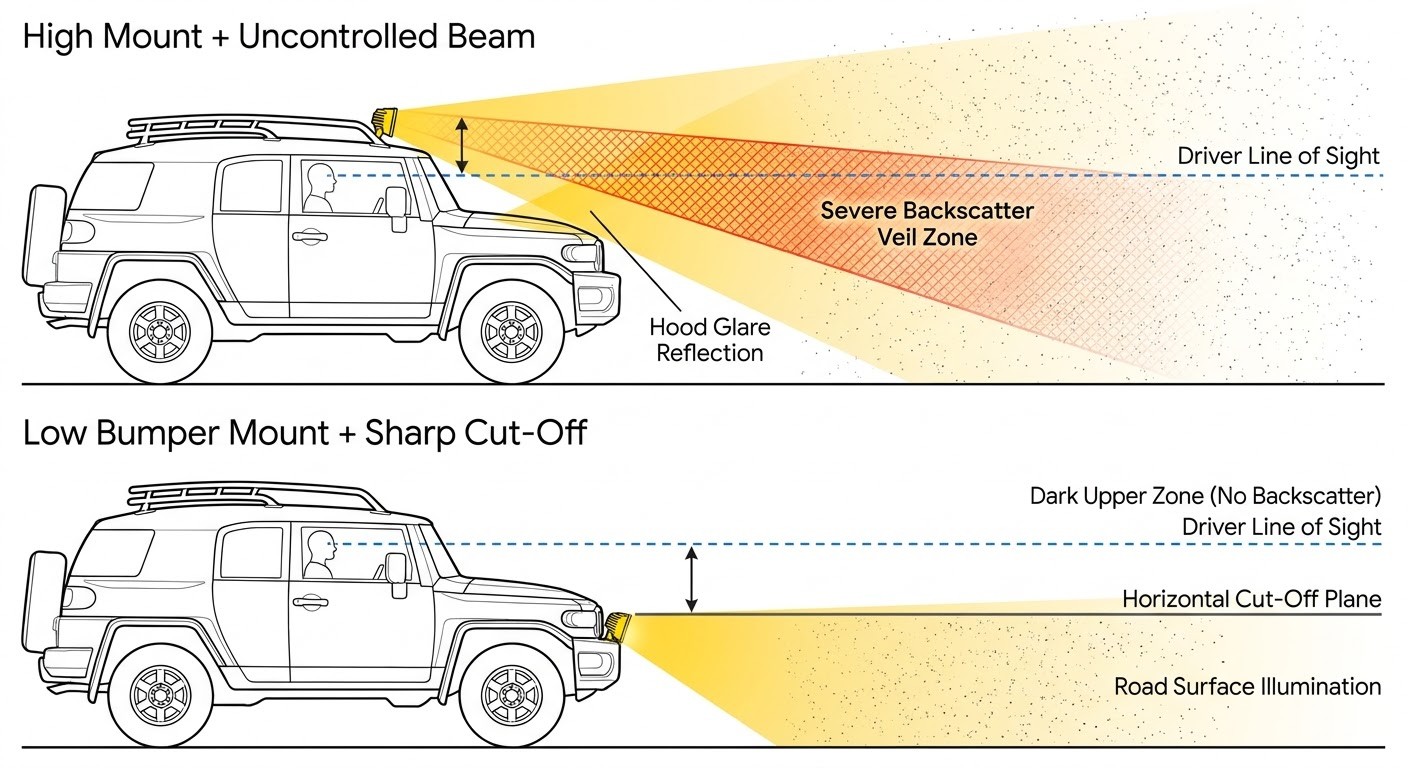
The most common cause of end-user dissatisfaction in the aftermarket is blaming lens colour for optical geometry failures. When an upfitter mounts an unshielded flood lamp near the driver’s roofline and activates it in fog or snow, the resulting glare is governed by physical geometry, not wavelength.
In a landmark field study for the Clear Roads winter maintenance consortium, Muthumani, Fay and Bullough (2015) proved that perceived backscatter glare (Vf) correlates at r² > 0.90 with the ratio of maximum luminous intensity (I, in candela) to the mounting distance (d, in metres) from the driver’s line of sight: Vf = I/d.
Simply put: mounting height and vertical cut-off gradient dominate colour. A lamp mounted low on the bumper (maximising d) with a flat horizontal cut-off keeps the upper atmospheric column dark, whereas a roof-mounted or A-pillar flood lamp (minimising d) illuminates precipitation directly in front of the windshield and reflects off the hood.
3.1 Specifying Yellow Pod Lights and Amber LED Light Pods (Fog Pockets, Bumper & Ditch Mounts)
Compact yellow pod lights and amber LED light pods (2-inch to 6-inch cube, round and flush-mount formats) represent the highest-volume SKU category for distributors because a single housing family can serve multiple vehicle zones depending on the internal optic:
- OEM fog pocket and low bumper replacements (SAE J583 / UN R149 Class F3). To be legally operated on public roads in North America (SAE J583, California Vehicle Code § 24403) and Europe or Australia (UN R149, ADR 13/00), front fog pods must be mounted symmetrically between 250 mm and 800 mm (12–30 inches in California) above the ground, never higher than the low-beam headlamps. They must project a wide horizontal bar (70°–80° H × 6°–8° V) with a sharp horizontal cut-off aimed 4 inches below lamp centre at 25 feet (0.76° downward pitch) and maintain thermal cut-off drift Δr ≤ 3.0 mrad.
- Off-road trail, bumper and A-pillar ditch pods. For off-highway trail rigs, UTVs and work trucks, DXZ’s 42-model off-road pod and auxiliary series provides purpose-built optical distributions across both bracket-mount and flush-mount housings:
- Forward spot and dual-colour pods: models such as the PY35-1-Spot (3.5″ round dual-colour white/yellow option), BF4-9 (4″ 9-lens spot pod with yellow cross-shaped DRL) and BF3-A4por / BF3-B4por (3″ bracket and flush-mount spot pods) concentrate high candela downrange for trail speed.
- Wide flood and combo pods: models such as the BF3-A20 / BF3-B20 (flood) and BF3-A6por / BF3-B6por (spot + flood combo) provide wide ditch, cornering and rear or side work illumination. When mounted on A-pillar ditch brackets, amber pod lights should be aimed 25°–45° outward toward the trail shoulders to illuminate obstacles without bouncing glare off the vehicle’s hood.
3.2 Engineering an Amber LED Light Bar or Yellow Light Bar Setup (Grille vs. Overhead Roof Racks)
When customers search for an amber LED light bar or yellow light bar (spanning 10-inch bumper bars to 50-inch roof bars), B2B category managers must guide them through two critical engineering realities:
- Statutory road-use rules for driving beams and light bars. Under UN Regulation No. 149, ADR 13/00, China GB 4599-2024 and SAE J581, any lamp or light bar approved as a road-legal auxiliary driving lamp (high-beam supplement) must emit white light and be interlocked with the high-beam switch. A dedicated yellow or amber light bar cannot be legally operated as a highway high beam in these jurisdictions, and in California under CVC § 24411, off-road light bars must be covered with an opaque cover on public roads. Consequently, DXZ engineers dual-function architectures — such as the RL2C-10 frameless LED light bar with dual-side white + yellow DRL and the 7-inch (7R01–7R05), 9-inch (9R01–9R05) and 10-inch (10C01–10C05) spot + DRL driving light platforms — that pair a powerful white spot beam with an independently switched yellow/amber DRL or dual-colour mode, alongside snap-on selective-yellow polycarbonate covers for Australian and European outback fleets.
- Bumper or grille vs. roof-rack placement. A 20-inch or 30-inch yellow light bar (such as DXZ’s 20C01 / 20C02 series) mounted inside the lower bumper opening or bull bar sits well below the driver’s sightline (d ≈ 0.8–1.2 m), making it highly effective in snow, dust and fog. Conversely, a 40-inch or 50-inch overhead roof-rack bar sits inches from the top of the windshield (d ≈ 0.2–0.3 m); it should use a tight spot beam for clear-night desert reach and must be switched off in fog or falling snow to prevent upper-windshield backscatter.
3.3 B2B Decision Table 1: Form Factor & Beam Pattern Selection Matrix
Use the engineering matrix below to structure your dealer catalogue, upfitter recommendations and OEM/ODM SKU assortment.
| Form factor & optical class | Typical beam angles (H° × V°) | Optimal spectral specification | Recommended mounting zone & height | Primary use case & regulatory status | Upfitter guardrail (Vf = I/d) |
|---|---|---|---|---|---|
| 3″–4″ cut-off fog pod lights (yellow pod lights) | 70°–80° H × 6°–8° V (sharp horizontal cut-off) | Selective yellow (575–585 nm; 4000K LED + doped yellow TIR) | OEM fog pockets or low front bumper (250–800 mm / 12–30 in) | On-road and off-road fog, rain, blizzard and wet asphalt; legal for highway use under SAE J583 F3 and UN R149 Class F3 | Never substitute unshielded flood pods into highway fog pockets; aim the top cut-off 4 in below lamp centre at 25 ft (0.76° down) |
| 3″–5″ off-road spot / combo pods (amber LED light pods, e.g. DXZ BF4-9, PY35-1, BF3-A6por) | Spot 6°–12°; combo 10° spot + 40°–60° flood | Dual-colour white + yellow, or PC-Amber (589–592 nm) | A-pillar ditch brackets, bumper tabs or flush-mount rear bumper (BF3-B6por) | Trail cornering, ditch hazard spotting and dust-convoy navigation; off-highway use (independent switch) | Aim A-pillar ditch pods 25°–45° outward; forward-aimed cowl floods create severe hood glare and snow bounce-back |
| 3″–6″ heavy-duty work & scene pods (amber pod lights, e.g. DXZ BF6-1F-20, BF3-A20) | Wide flood 60°–120° H × 40°–60° V | PC-Amber (590 nm), or white + amber DRL | Rear chase rack, service-body perimeter, excavator boom or snowplow wing | Rear dust and chase conspicuity, open-pit mining haul roads (MDG 2007), agricultural spraying | Specify CISPR 25 Class 5 EMC for mining and ag machinery; specify heated lenses below −5 °C for winter snowplow fleets |
| 7″–10″ round and rectangular driving lights (yellow driving lights, e.g. DXZ 7R01–7R05, 9R01–9R05, 10C01–10C05) | Long-range spot 5°–10° (43–105 W) + independent DRL | White spot main + yellow/amber DRL (or selective-yellow snap-on cover) | Front bull bar, nudge bar or heavy-truck grille guard (400–1,067 mm) | High-speed overland, outback highway transport, desert racing; white main beam required for UN R149 / ADR 13/00 / SAE J581 | Wire the main beam via high-beam interlock (CANM8 on CAN-bus rigs) and wire the yellow/amber DRL to an independent position or accent circuit |
| 10″–30″ bumper / grille LED light bars (amber LED light bar, e.g. DXZ RL2C-10, 20C01, 20C02) | Single or dual-row spot, or spot + flood combo, plus dual-side DRL | Selective yellow (575 nm), or white + yellow dual-mode | Lower bumper valence opening or winch cradle (350–750 mm) | Mid-to-long-range trail sweep and low-angle snow or dust illumination; maximises sightline separation d | Ensure adequate airflow behind recessed grille mounts so high-wattage bars do not prematurely trigger thermal foldback |
| 40″–50″ overhead roof-rack light bars (yellow light bar) | Narrow spot or long-throw combo | Selective yellow (575 nm), or white with amber rock guards | Above-windshield roof rack or pickup headache rack | High-speed clear-air or low-lying desert silt illumination over terrain crests | Mandatory cut-off in fog or snow: minimal separation d from the driver’s eyes causes immediate windshield white-out in precipitation; use an opaque cover on highway (CVC § 24411) |
4. Automotive-Grade Quality Audit: Eliminating RMA Risks in Optical, Structural & Electronic Design
For wholesale distributors and private-label brand owners, the true cost of an auxiliary lamp is not its unit FOB price — it is the Return Merchandise Authorization (RMA) rate, warranty freight cost and brand reputation damage caused by field failures. Below are the three engineering pillars that separate automotive-grade manufacturing from commodity marketplace assembly.
4.1 Lens Material Chemistry: Stopping Polycarbonate UV Yellowing (Photo-Fries) and Thermal Crazing
Outer lenses on off-road pods and light bars must survive high-velocity gravel impacts (requiring IK10 impact resistance), which makes polycarbonate (PC) the dominant engineering thermoplastic over brittle glass or low-impact PMMA (acrylic). However, raw, unstabilised polycarbonate suffers from a severe chemical vulnerability: UV-induced Photo-Fries rearrangement and photo-oxidation (The Madison Group; Tough Lighting).
When exposed to solar UV radiation (290–380 nm), aromatic carbonate linkages within the top ≈25 µm of an untreated PC lens cleave and rearrange into phenyl salicylates, dihydroxybenzophenones and quinonoid structures. Within 2 to 4 months of intense desert sun (or 1–2 years in temperate climates), the lens develops a muddy brown-yellow haze and micro-cracks, and loses up to 30% of its optical transmission.
Furthermore, selective-yellow and amber lenses run significantly hotter than clear lenses. Because a subtractive yellow lens absorbs short-wavelength blue radiant energy and converts it into heat, independent thermal imaging on a 36 W fog pod after 10 minutes of operation recorded a yellow lens surface temperature of 170 °F (76.7 °C) compared to 137 °F (58.3 °C) on an identical white pod (TacomaWorld dataset). To prevent thermal crazing and UV degradation, B2B buyers must specify:
- Optical-grade UV-stabilised PC resin plus silicone hardcoat. Compounded with synergistic UV absorbers (UVA) and hindered amine light stabilisers (HALS, such as automotive grade A1225) and finished with a scratch-resistant optical silicone hardcoat lacquer, validated against 3,000-hour QUV accelerated weathering.
- Bulk-moulded colour rather than dichroic coatings. Specify bulk-dyed optical polycarbonate or PMMA internal TIR optics rather than cheap vacuum-deposited dichroic interference coatings, which diffract blue light off-axis and project stray blue rings above the horizontal cut-off (Daniel Stern Lighting).
4.2 Ingress Protection & Thermal Management: IP68/IP69K, ePTFE Breathers and Copper-Core MCPCBs
Why do cheap “IP67/IP68” off-road lights still fill with condensation after a single river crossing or car wash? The culprit is the thermal siphon (capillary wicking) effect.
When an LED driving light operates at full load, its internal air cavity heats to 70–85 °C, increasing internal pressure. When the hot lamp is suddenly doused with cold water (10 °C), the internal air cools and contracts rapidly, creating a strong partial vacuum inside the housing. If the lamp uses a bare cable passing through a basic rubber grommet, that vacuum sucks water straight through the microscopic gaps between the stranded copper wires — or draws moisture past the main silicone lens gasket.
To achieve true IP68 (1.5 m submersion) and IP69K (80 °C high-pressure steam jet at 80–100 bar) reliability across DXZ’s driving and work light platforms, three structural defences are required:
- Integrated overmoulded Deutsch DT/DTP receptacles. Sealing the copper pins directly inside the connector body eliminates bare-wire capillary wicking into the lamp cavity.
- Microporous ePTFE breather membranes. A hydrophobic expanded polytetrafluoroethylene vent equalises air pressure continuously during −40 °C to +85 °C thermal cycling while blocking water molecules, mud and salt crystals.
- High-conductivity thermal path and ETM. High-power LEDs require copper-core or high-conductivity MCPCBs (avoiding cheap dielectric layers that add up to 50 K/W thermal resistance), JEDEC J-STD-020C reflow soldering (260 °C peak, zero thermal-pad voiding), die-cast ADC12 aluminium housings passing 240-hour ISO 9227 neutral salt-spray testing, and electronic thermal management (ETM) PWM foldback that throttles current smoothly if the vehicle is stationary in high ambient heat.
4.3 Driver Electronics & EMC: CISPR 25 Class 5, ISO 7637-2 Pulse 5a and Dual-Colour MCU Synchronisation
In commercial fleet, agricultural and mining tenders, electronic driver failures and radio frequency interference (RFI) are deal-breakers:
- EMC compliance (UN Regulation No. 10 and CISPR 25 Class 5). High-frequency buck or buck-boost constant-current LED drivers switch at 100 kHz–2 MHz. Without multi-stage π-filters, common-mode chokes and shielded inductors, radiated emissions wipe out VHF/UHF two-way radios, DAB+/FM antennas, RTK-GPS tractor guidance and mine-site collision avoidance technology (NSW MDG 2007). DXZ provides certified ECE R10 (E24 / E57), CE-EMC (EN IEC 55015 / 61547) and FCC Part 15 Subpart B documentation to protect importers.
- Wide-voltage and load-dump surge protection (ISO 7637-2 Pulse 5a). Heavy trucks, excavators and mine haulers run on 24 V nominal (28.0 V charging) electrical architectures. Disconnecting a corroded battery cable while the alternator is charging generates a violent inductive load-dump transient (ISO 7637-2 Pulse 5a) exceeding 36–60 V. Drivers must incorporate 12–30 V DC / 9–32 V DC wide-voltage topology, reverse-polarity MOSFETs and automotive TVS (transient voltage suppressor) diodes.
- Dual-colour (white/yellow) MCU state synchronisation. On switchable dual-colour lamps (such as DXZ’s PY35-1 dual-colour pods or white + yellow driving series), cheap toggle-switch RC capacitor circuits quickly lose synchronisation when subjected to vehicle voltage drops or CAN-bus PWM cold and warm bulb-check pulses — leaving the left lamp burning 6000K white while the right lamp burns 3000K yellow (NVEL Tech, 2025). Automotive-grade dual-colour drivers use a dedicated MCU with filtered reset-window timing (for example, >3 s power-off reset to default state) or a dedicated 3-wire / 4-wire trigger lead to guarantee 100% left-to-right colour synchronisation.
4.4 B2B Decision Table 2: Automotive-Grade Sourcing & QC Verification Checklist
Before approving a production golden sample or signing an OEM/ODM contract, B2B procurement teams should audit the supplier against this six-point verification matrix.
| Audit dimension | Engineering parameter | Commodity / marketplace failure mode | Automotive-grade OEM specification (DXZ lab standard) | Verification test & acceptance threshold |
|---|---|---|---|---|
| 1. Colorimetry & binning | CIE 1931 (x, y) coordinates and hot binning | Unfiltered 3000K white LED sold as yellow; unbinned reels causing left/right colour mismatch | InGaN PC-Amber (589–592 nm) or 4000K LED + doped selective-yellow TIR; hot-binned at Tj = 85 °C | Integrating-sphere test after 15 min thermal stabilisation per UN R48 §2.11.1.2 / SAE J578; batch Δx, Δy ≤ ±0.005 |
| 2. Thermal droop & optics | Hot/cold lumen ratio (Lm H/C) and beam cut-off | Direct AlInGaP loses 63.8% output at 85 °C (+5.6 nm red shift); 50.6% loss from dark amber covers | Lm H/C ≥ 0.85–0.87 at 85 °C; ≤9% filter loss on selective-yellow TIR; darkroom goniophotometry | Pulsed vs. 85 °C steady-state flux ratio ≥ 0.85; UN R149 / SAE J583 vertical cut-off drift Δr ≤ 3.0 mrad |
| 3. Lens weathering & impact | Polymer formulation and surface hardcoat | Recycled or unstabilised PC yellows and hazes in 2–4 months via Photo-Fries rearrangement | Virgin optical PC + UVA/HALS (A1225) + dual-side silicone hardcoat, or tempered borosilicate glass | IK10 mechanical impact; 3,000 h QUV accelerated UV weathering without crazing; post-abrasion glare increase ≤30% |
| 4. Sealing & breathability | Cable gland, breather vent and housing finish | Bare wire grommet sucks water via capillary wicking during cold splash; non-vented seal blowouts | Overmoulded Deutsch DT/DTP receptacle + hydrophobic ePTFE breather vent; ADC12 aluminium + 304 SS brackets | IP68 (1.5 m for 30 min) + IP69K (80 °C, 80–100 bar); ISO 9227 240 h salt spray; 8–15 Grms vibration / 60G shock |
| 5. EMC & electrical surge | Driver topology, EMI filtering and transient protection | Unshielded buck converter wipes out FM/UHF radio and CAN-bus; 24 V alternator load-dump blows the IC | 9–32 V / 12–30 V DC constant-current driver + π-filter + TVS surge diode + MCU dual-colour sync | UN ECE R10 (E24/E57), CISPR 25 Class 3–5, CE-EMC, FCC Part 15B and ISO 7637-2 Pulse 5a (36 V continuous surge) |
| 6. Factory QC & warranty | In-house lab validation and batch claim protocol | No darkroom or environmental chamber; vendor refuses batch root-cause analysis | DXZ 12-step lab validation (sphere, darkroom, UV, salt, vibration, burn-in) + 3-year B2B warranty | Full English/Chinese integrating-sphere and isolux reports per SKU; formal 8D corrective action reporting on batch claims |
5. OEM/ODM Supply Chain Execution for Importers, Distributors & Private Label Brands
Translating optical engineering into a profitable regional product line requires a manufacturing partner capable of customising harnesses, brackets, branding and compliance documentation at speed. At DXZ Lighting’s Foshan manufacturing base — equipped with 8 dedicated production lines, 110 technical and R&D personnel and a daily output capacity of 12,500 units exported across 120+ countries — B2B programmes are structured around three operational pillars.
5.1 Harness & Connector Standardisation: Deutsch DT vs. DTP Sizing, CAN-Bus Triggers and Solid-State PDMs
Substandard wiring harnesses are the number-one cause of installation fires, voltage-drop dimming and blown fuses in the aftermarket. When specifying complete yellow driving lights or amber LED light bar kits, procurement managers must match the connector series and wire gauge (AWG) to the continuous electrical load (I = P / V at 12 V nominal):
- Deutsch DT series (up to 13 A continuous / ≤150 W at 12 V). Ideal for 3-inch to 6-inch yellow pod lights, amber pod lights and single-lamp work lights (such as DXZ’s BF3, BF4, PY35 and 7R01–7R05 series). Specify original-spec 2-pin Deutsch DT04-2P / DT06-2S (or 3-pin DT04-3P / DT06-3S for models with an independent yellow/amber DRL channel, such as the 7R/9R/10C driving lights and the RL2C-10 bar) paired with 16–14 AWG pure stranded copper wire and silicone wire seals.
- Deutsch DTP series (up to 25 A continuous / 150–300 W at 12 V). Mandatory for high-wattage pairs (such as pairs of DXZ’s 91–105 W 9R01–9R05 9-inch round driving lights drawing 15–17.5 A combined at 12 V) and high-output dual-row light bars. Upgrading from DT to DTP04-2P / DTP06-2S with 12–10 AWG pure copper wire prevents terminal pin overheating and eliminates resistive voltage drop (ΔV = 2IR).
- CAN-bus high-beam integration and solid-state PDM compatibility. Modern pickup trucks and 4x4s (Toyota Land Cruiser and Tacoma, Ford Raptor and Ranger, Jeep Wrangler JL, RAM) use CAN-bus controlled matrix or LED headlamps with no analogue 12 V high-beam trigger wire, alongside 80–400 Hz PWM lamp-check pulses. DXZ supports upfitters with harnesses engineered to interface with inductive CAN-bus high-beam decoders (such as CANM8 CANNECT), anti-flicker capacitor modules and 8-to-12-channel solid-state MOSFET power distribution modules (PDMs) such as Switch-Pros and sPOD.
5.2 Private Label Customisation: Tiered MOQs, Lead Times and Masterbatch Colour Locking
Whether you are launching a new private-label overland brand or expanding an established national distributor catalogue, DXZ’s OEM/ODM programme provides transparent, tiered scalability with strict bill-of-materials (BOM) locking to prevent batch-to-batch colour drift.
| Procurement tier | Minimum order quantity | Standard production lead time | Customisation scope & supply chain controls |
|---|---|---|---|
| 1. In-stock wholesale / trial order | 50 pieces (paid samples available; sample fee credited toward the bulk order) | 1–3 working days | Standard DXZ or neutral export packaging; full access to model-specific integrating-sphere and goniophotometric reports. |
| 2. Private label / laser logo | 100 pieces | 7–12 working days | Precision fibre laser engraving of your brand logo on the die-cast aluminium housing or bezel; locked LED chromaticity bin codes. |
| 3. Custom branded retail packaging | 1,000 pieces | 7–12 working days | Custom die-cut EPE foam inserts, full-colour retail gift boxes, custom barcode and SKU labelling, user manuals and tailored Deutsch DT/DTP harness kits. |
| 4. Full new-mould ODM development | 5,000 pieces | 30–40 working days | Custom 3D optical simulation, bespoke TIR or reflector mould tooling, proprietary housing appearance with Chinese and international design patent protection, and dedicated ECE E24/E57 (R10/R148/R149) homologation. |
5.3 Zero-Defect Quality Control: DXZ 12-Step Lab Validation, 8D Reporting and the 5-Step Buyer Field Audit
To eliminate the “spec-sheet inflation” that plagues the off-road lighting industry, every DXZ product platform undergoes a mandatory 12-step in-house laboratory testing protocol covering integrating-sphere photometry, darkroom goniophotometry, rain simulation, dust chamber, QUV ultraviolet ageing, high and low temperature and humidity cycling, random vibration, salt-spray corrosion, thermal ageing burn-in and airtightness leak verification. Every shipment is backed by DXZ’s 3-year B2B warranty, which includes spare-parts support, replacement, credit settlement and formal 8D failure analysis and corrective action reporting for recurring or batch enquiries.
The 5-step non-instrumented buyer field audit (for trade shows and incoming QC). When evaluating samples at industry exhibitions — such as DXZ’s booths at SEMA Las Vegas (Booth 60206), AAPEX Las Vegas (Booth F11201) or Automechanika — procurement engineers can spot inferior lamps in five minutes without laboratory gear:
- Grazing-angle lens check. Inspect the unlit yellow lens at a sharp grazing angle under white light. A bulk-dyed selective-yellow PC lens shows a uniform golden hue; a cheap dichroic coating shows a bluish-iridescent mirror reflection that causes stray glare.
- Three-metre wall cut-off and fringe check. Project the beam onto a wall at 3–5 m. Verify that fog models display a razor-flat horizontal cut-off with zero upward stray light and no blue chromatic fringing around the perimeter.
- Rear breather and connector check. Confirm the presence of a dedicated microporous ePTFE breather vent and an overmoulded Deutsch DT/DTP connector rather than an unsealed rubber wire grommet.
- Ten-minute thermal droop and red-shift check. Power the amber or yellow lamp at 13.5 V for 10 minutes. If brightness visibly collapses by more than half and the colour shifts from gold-amber to deep blood-orange, reject the sample — it uses direct AlInGaP LEDs instead of InGaN PC-Amber.
- Handheld FM radio EMI check. Place a portable FM radio tuned to a weak station next to the operating lamp and driver cable. Audible static hiss indicates an unfiltered buck switching node that will fail CISPR 25 / UN R10 EMC testing.
6. Frequently Asked Questions for B2B Lighting Buyers
Are yellow driving lights or amber LED light bars street legal in the US, Europe and Australia?
Legality depends strictly on the functional lamp category. Across the US (SAE J583, CVC § 25950), Europe (UN Regulation No. 48 and UN Regulation No. 149), Australia (ADR 13/00) and China (GB 4599-2024), front fog lamps are legally permitted to emit selective yellow (or white). Conversely, road-approved auxiliary driving lamps (high-beam supplements) under SAE J581, UN R149 and ADR 13/00 must emit white light. Dedicated yellow or amber spot pods and light bars are classified for off-road or stationary work use, or require removable selective-yellow covers over a compliant white driving lamp.
Does a yellow or amber DRL mean the main driving beam is also yellow?
No. On multi-function auxiliary lamps — such as DXZ’s 7-inch (7R01–7R05), 9-inch (9R01–9R05) and 10-inch (10C01–10C05) spot + DRL LED driving lights — the high-output spot main beam and the white + yellow DRL or position accent operate on separate circuits. Always confirm whether your project requires a yellow main beam, a switchable dual-colour main beam (like the PY35-1-Spot) or a white main beam with an amber DRL channel.
Why should our catalogue offer both selective yellow (575 nm) and amber (590 nm) SKUs?
Because they serve distinct buyer segments. Selective yellow (≈575–585 nm) retains 91–93.4% of photopic lumen output while eliminating blue glare, making it the top seller for daily-driven trucks, SAE/ECE fog replacements and high-speed winter or rain driving. True amber (≈590 nm PC-Amber) provides maximum colour saturation and chromatic contrast, making it the preferred choice for desert racing dust and chase lights, open-pit mining fleets and customers matching factory amber OEM grille markers.
What is the minimum order quantity and lead time for DXZ private-label or OEM/ODM orders?
DXZ supports flexible B2B scaling: standard in-stock trial orders start at 50 pieces (shipped in 1–3 working days), custom laser logo engraving starts at 100 pieces (7–12 working days), customised branded colour boxes start at 1,000 pieces (7–12 working days) and full new-mould ODM development starts at 5,000 pieces (30–40 working days). Paid evaluation samples are available and credited toward your formal bulk order.
7. Partner with DXZ Lighting for Evidence-Backed OEM/ODM Supply
Building a market-leading line of yellow driving lights, amber pod lights and amber LED light bars requires more than an attractive housing — it requires verifiable photometric data, locked colorimetric binning and bulletproof compliance documentation.
Whether you are shortlisting SKUs for regional wholesale distribution, developing a private-label overland series or specifying heavy-duty 12–30 V work and driving lamps for commercial fleets, DXZ Lighting is ready to support your engineering and procurement teams:
- Explore product platforms: browse the complete ranges of LED driving lights (7″, 9″ and 10″ series), LED off-road pods and flush-mount kits (42 models) and frameless and DRL LED light bars.
- Request lab test records and compliance files: contact the engineering team for model-specific integrating-sphere colorimetric reports, darkroom goniophotometric isolux maps and ECE E-Mark (R10/R148/R149), CE-EMC, RoHS and FCC certificates (view the OEM/ODM and certification library).
- Meet DXZ in person or request a sample kit: visit SEMA 2026 (Booth 60206, Las Vegas) and AAPEX 2026 (Booth F11201, Las Vegas), or contact the Foshan headquarters at info@dxzchina.com / +86-17675772057 to arrange paid evaluation samples (credited toward your bulk order) and a customised OEM/ODM quotation within 24 hours.