Many lighting suppliers say they design their own products. For a buyer, the more useful question is narrower: can the supplier show who the registered right holder is, what design is protected, and where that protection applies?
For products in the DXZ portfolio, our evidence file contains 62 CNIPA design-registration records filed and granted between 2019 and 2022. All 62 records list our founder as the registered right holder.
This page shows what those registrations cover — complete lamps, individual components and packaging — what they do not establish, and how a buyer can verify a supplier’s design claim independently.
A design registration can identify a protected appearance and its registered right holder. It does not, by itself, establish tooling ownership, buyer exclusivity, manufacturing capacity or product performance.
This page covers the 62 CNIPA design registrations in the DXZ evidence file, and the question a buyer is really asking: who is the registered right holder, what does each registration cover, and what can be checked independently.
It is not a survey of the industry, and it is not a statement about performance. A design registration protects how a product looks, never how it performs — the performance evidence lives in the other studies in this library.
- Registered designs
- 62
- Registered right holder
- Founder / individual
- Filed / granted
- 2019–2022
- Source
- CNIPA registry copies
- Copy status
- Recorded in force when issued, April 2023
- The evidence file contains 62 distinct CNIPA design registrations, each with a unique patent number and a unique certificate number. All 62 list our founder, an individual, as the registered right holder.
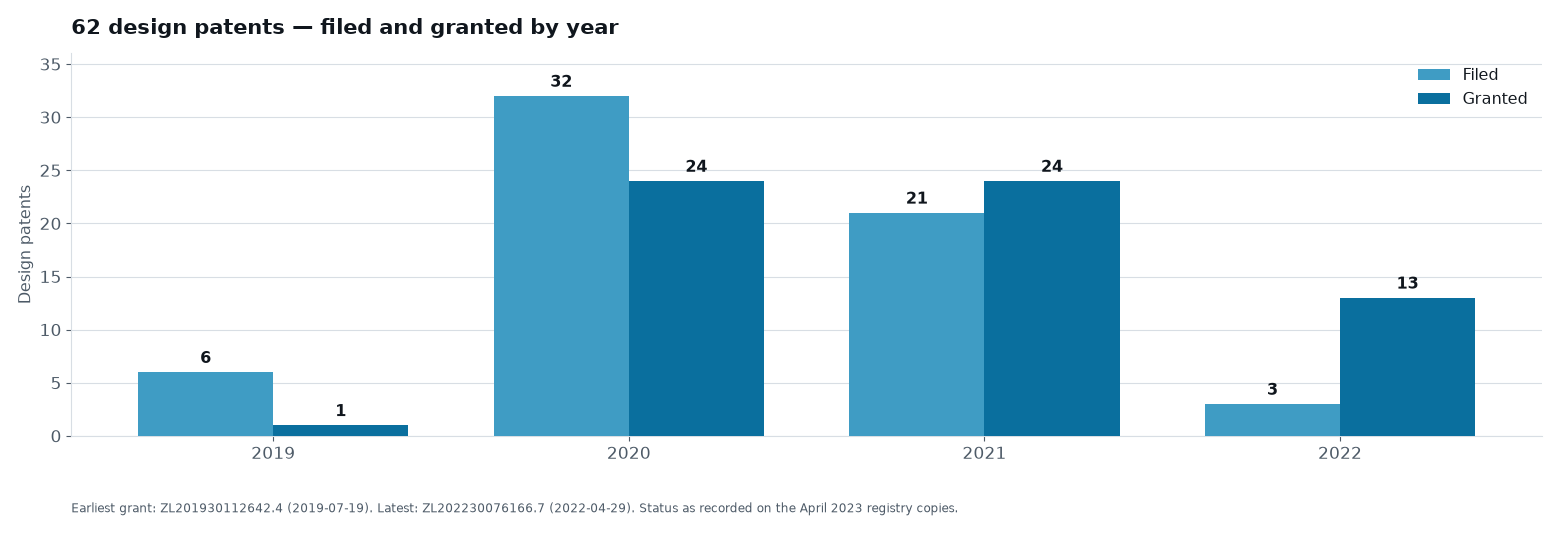
- They were filed 2019–2022 (6 / 32 / 21 / 3 by year) and granted 2019–2022 (1 / 24 / 24 / 13). The earliest grant is a 2019 marker lamp; the most recent is a 2022 packaging design.
- They are not all complete lamps. 9 of the 62 protect a single component — a face cover, a reflector cup, a headlight driver box, a strobe-controller housing — and 8 protect packaging.
- Our evidence file contains signed certificate scans for 59 of the 62. For three designs we have the registry record but no scanned certificate, and we name them rather than round the number up.
- The registry copies in the file were issued in April 2023. They record the position at that date; anyone relying on a registration today should check its current status in the official register. That includes checking ours.
- You do not have to take any of this on trust. There is a three-step check any buyer can run on any supplier’s design claim — we list it, and we expect it to be applied to us first.
On this page
- Whose Design Is Registered?
- 62 Registered Designs and Their Recorded Status
- What the Registrations Cover
- Component-Level Registrations
- Packaging Registrations
- What These Registrations Do — and Do Not — Establish
- How Buyers Can Verify a Supplier’s Design Claim
- Inside the Owl Series
- What This Means for a Private-Label Project
- FAQ
Whose Design Is Registered?
Design registration and tooling ownership are two different questions. A registered design identifies the protected appearance and its registered right holder. Tooling ownership, manufacturing access and buyer exclusivity depend on separate commercial or contractual arrangements.
That is why “we customise” and “the design is registered, to this holder” are different claims, and why the second one is worth more to a buyer with a project on the line. Almost every supplier makes the first claim. The second is documentary: a patent number, a certificate, a named holder and a checkable status.
It is also why the holder line matters more than the count: a register entry names the party the right is registered to, and if that party is not the company you are buying from, that is a question worth asking early.
The rules cited on this page are institutional, not our own findings: a design right protects appearance rather than function, and it is territorial. Primary sources: the China National Intellectual Property Administration and the WIPO Hague System.
62 Registered Designs and Their Recorded Status
Here is our own position. Every registration discussed on this page is backed by a certificate-registry copy issued by CNIPA. Those copies are machine-readable, and we extracted each one — patent number, certificate number, filing date, grant date, recorded legal status and holder — rather than counting filenames in a folder.
| Item | Value |
|---|---|
| Registered designs | 62 |
| Unique patent numbers | 62 |
| Unique certificate numbers | 62 |
| Legal status | 62/62 recorded as in force on the April 2023 registry copies |
| Filed | 2019–2022 |
| Granted | 2019–2022 |
| Registered right holder | Our founder, an individual |
| Certificate scans on file | 59 |
Four details in that table are worth stating outright, because each is the kind of thing a rounded number hides.
First, the count is 62, not “about 60”. Sixty-two distinct patent numbers and sixty-two distinct certificate numbers mean sixty-two registrations — no duplicate counted twice, no single design split into two entries.
Second, the dates run 2019 to 2022. The registry copies were issued in April 2023, which is a property of when we ordered the copies, not of when the registrations were filed or granted. Filings peaked at 32 in 2020; grants at 24 in 2020 and 24 in 2021. The earliest grant in the set is a marker lamp (ZL201930112642.4, granted 2019-07-19); the most recent is a packaging design (ZL202230076166.7, granted 2022-04-29).
Third, on legal status, we can only tell you what our copies record. The April 2023 copies recorded all 62 designs as in force at the time those copies were issued — a dated statement, and we are keeping it dated. Design rights are maintained by annual fees and can be terminated, surrendered or invalidated. Anyone relying on a registration today should check its current status in the official register, and that includes checking ours.
Fourth, and this is the part most suppliers would leave out: our evidence file contains signed certificate scans for 59 of the 62. For three designs we have the registry record — documentation that the registration exists — but no scanned certificate in the file. We would rather name them than present a clean 62:
- Vehicle LED projector headlight, series (车辆LED透镜大灯(系列)) — ZL202130058303.X
- Packaging box, work light (包装盒(工作灯)) — ZL201930480372.2
- Vehicle marker lamp (T10-3030-4LED) (汽车示宽灯(T10-3030- 4LED)) — ZL201930112642.4
What the Registrations Cover
Sixty-two registrations is a number until you ask of what. The set clusters around the product lines we develop most, which is what you would expect from a programme that follows real product development rather than a paperwork exercise.
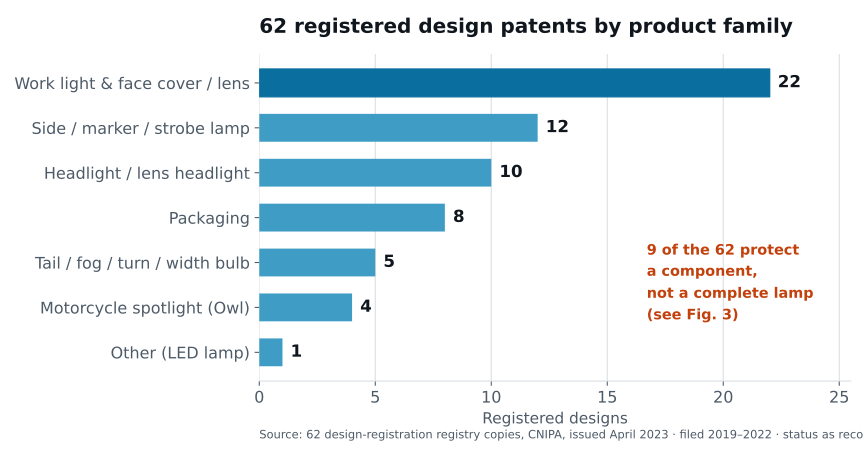
| Product family | Designs |
|---|---|
| Work light & face cover / lens | 22 |
| Side / marker / strobe lamp | 12 |
| Headlight & lens headlight | 10 |
| Packaging | 8 |
| Tail / fog / turn / width bulb | 5 |
| Motorcycle spotlight (Owl series) | 4 |
| Other (single lamp) | 1 |
| Total | 62 |
The work-light family leads because that is where the most variants exist — different mounting forms, reflector arrangements and lens shapes for the same underlying application. Vehicle lighting is bought by application, and each application tends to push the housing and the beam-forming face into a different shape. That is precisely the surface a design registration covers.
Two entries in that table are easy to skim past, and both are more interesting than they look. There are 8 packaging registrations, and 9 registrations that cover a single component rather than a whole lamp. We will take them in turn.
Component-Level Registrations
Most design programmes stop at the finished product. The harder and less common habit is to register the parts inside it as well — recorded under their own names and their own patent numbers, separately from the complete lamps they fit into.
Nine of the 62 are exactly that. They cover:
- 5 vehicle work-light face covers — the visible lens/bezel face, including four distinct reflector-cup variants;
- 2 further lamp covers — a multi-mode work-light cover and a mini work-light cover;
- 1 vehicle headlight driver box — the electronics housing, not the lamp;
- 1 strobe-lamp controller housing — again the enclosure, not the light.
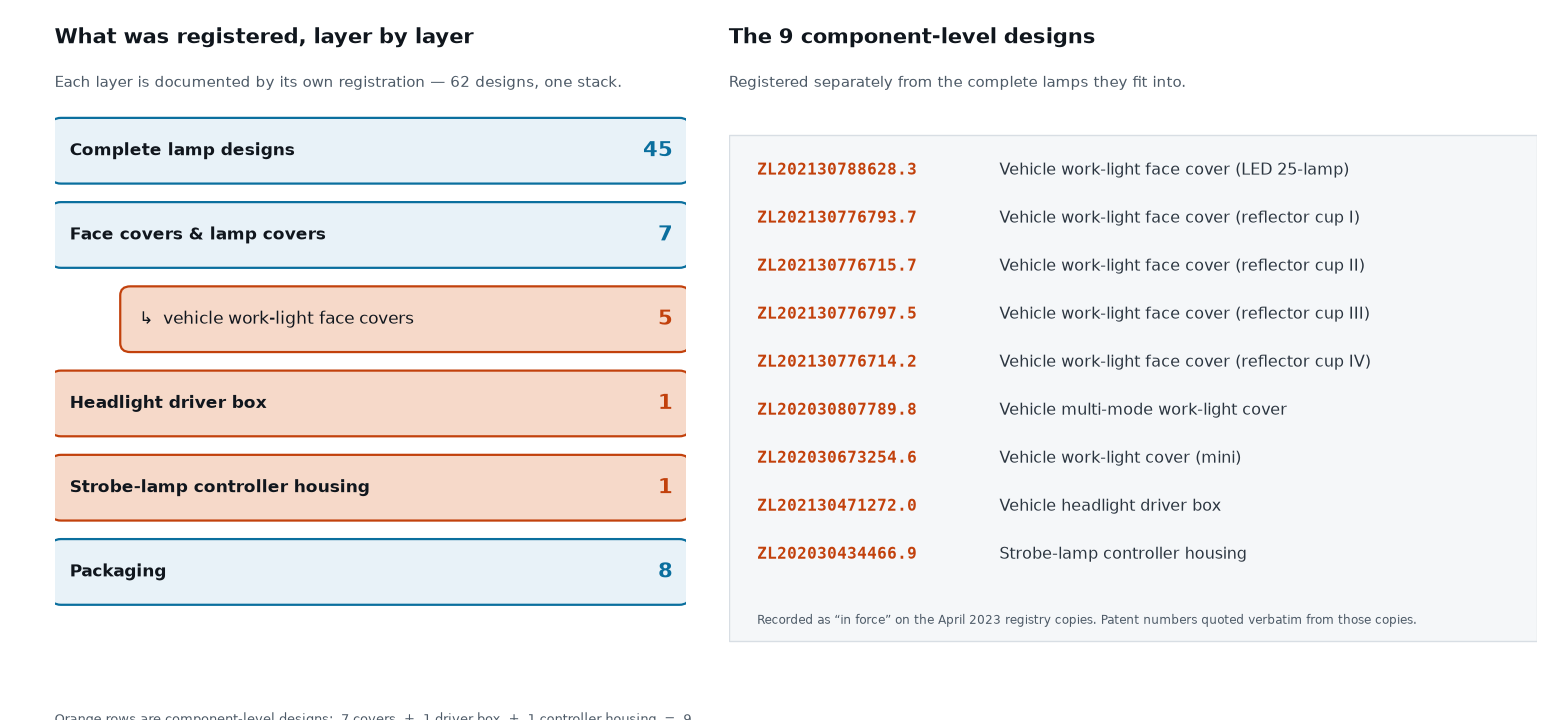
| Patent number | Design (English) | Original name |
|---|---|---|
| ZL202130788628.3 | Vehicle work-light face cover, LED 25-lamp | 车辆工作灯面盖(LED 25灯) |
| ZL202130776793.7 | Vehicle work-light face cover, reflector cup I | 车辆工作灯面盖(LED灯反光杯一) |
| ZL202130776715.7 | Vehicle work-light face cover, reflector cup II | 车辆工作灯面盖(LED灯反光杯二) |
| ZL202130776797.5 | Vehicle work-light face cover, reflector cup III | 车辆工作灯面盖(LED灯反光杯三) |
| ZL202130776714.2 | Vehicle work-light face cover, reflector cup IV | 车辆工作灯面盖(LED灯反光杯系列四) |
| ZL202030807789.8 | Vehicle multi-mode work-light cover | 车辆多模式工作灯盖 |
| ZL202030673254.6 | Vehicle work-light cover, mini | 车辆工作照明灯盖(迷你款) |
| ZL202130471272.0 | Vehicle headlight driver box | 车辆大灯驱动盒 |
| ZL202030434466.9 | Strobe-lamp controller housing | 爆闪灯控制器外壳 |
What this changes is the granularity of the documentary record, not the legal reach of any single right. Component-level registrations extend the record beyond complete lamps, so a buyer looking at a face cover, a driver box or a controller housing has specific registrations to ask about rather than a single product-level entry. Whether a component registration gives exclusivity, control of tooling or freedom to operate is a separate question — answered by the agreements behind the project, not by the certificate.
Packaging Registrations
Packaging can itself form part of a product’s visual identity. Eight of the 62 registrations cover packaging rather than the lamp itself.
Those registrations document protected packaging appearances separately from the lighting products they accompany. They cover work-light boxes, vehicle atmosphere-light boxes, an off-road modification-light box, a general LED lamp box and the headlight box for the Owl series.
Why we register packaging comes down to what a delivered product actually is. A box with a distinctive shape, a specific layout and a recognisable silhouette is part of how a product is identified before it is ever opened. Registering the packaging documents that appearance in the same record as the lamp it carries, rather than leaving it undocumented.
What These Registrations Do — and Do Not — Establish
This is the section that keeps the page honest, and it matters more than the count.
A design registration is not evidence of performance. It is granted for novelty and distinctiveness of appearance. It is not examined for brightness, beam quality, colour temperature, colour rendering or how long a product lasts. A company can hold two hundred design registrations and still build a lamp that underperforms; a company can hold none and build an excellent one. Function and appearance are simply different things, examined by different systems for different reasons.
It is worth separating four questions that are often bundled into one sentence:
- A design registration identifies a protected appearance and the party it is registered to.
- Tooling ownership is a commercial question about who owns or controls the mould.
- Licensing and buyer exclusivity are contractual questions about who may use what, for which market and for how long.
- Product performance is a measurement question, answered by testing rather than by certificates.
Keeping them apart is not pedantry. It is the difference between a sourcing decision made on documented facts and one made on a sentence that sounded reassuring.
| Question | What the evidence establishes |
|---|---|
| How many registrations are in the evidence file? | 62 distinct CNIPA design registrations |
| Who is the registered right holder? | The founder is listed as the holder on all 62 registry copies |
| Do the registrations prove tooling ownership? | No. Tooling ownership is a separate commercial issue |
| Do they give a private-label buyer exclusivity? | No. Buyer exclusivity depends on the relevant agreement |
| Do they establish product performance? | No. Performance requires measurement and testing evidence |
| Do they prove DXZ is a factory? | No. Design-registration evidence does not establish manufacturing status or capacity |
| Do Chinese registrations apply worldwide? | No. Design rights are territorial |
| Can current legal status change? | Yes. Current status should be checked in the relevant official register |
- These are Chinese (CNIPA) design registrations. They do not automatically establish design rights in the United States, the European Union or other jurisdictions; protection elsewhere would require separate filings, and a registration does not travel with the product.
- The registered right holder is our founder, an individual, not the company. We state it because a buyer should know it, not have to infer it.
- The recorded status is dated April 2023. Design rights are maintained by annual fees and can end; check the current register before relying on any individual registration.
- Three designs have no certificate scan on file. The registry record exists; the scanned certificate does not.
- A registration records a right; it does not establish that the right is being enforced or that any particular third-party product is affected.
This page is intended as a sourcing and evidence-verification resource, not legal advice. For project-specific freedom-to-operate, licensing or infringement questions, consult qualified counsel in the relevant jurisdiction.
If what you actually need is evidence of performance, that is a different kind of evidence, and it lives elsewhere in this library — a goniophotometer scan shows beam distribution, and a repeat-test consistency study shows whether a second measurement matches the first. Registrations tell you what is documented and to whom. Measurements tell you how the product behaves. Two different records, and we publish both.
How Buyers Can Verify a Supplier’s Design Claim
None of the above is worth much if you have to take a supplier’s word for it. You do not. Design registers are public, and the check takes about ten minutes per supplier.
- Step 1 — Ask for the number, not the trophy
- Request the patent number (or registration number) and the certificate number for each design the supplier says covers your product, together with the design name it is registered under and the registered right holder. A photograph of a framed certificate proves nothing on its own; the number is the part that can be checked.
- Step 2 — Check the register, and note the date you checked
- Enter the number in the official register for the country of filing and confirm four things: the design name matches the product, the registered right holder is who you were told, the legal status is what you expected, and the territorial scope covers the market you are buying for. Record the date of your check — a status is only true as of the day it was read.
- Step 3 — Ask what connects the supplier to the holder, and what else is registered
- If the registered right holder is not the company selling to you, ask what authorisation or agreement connects them — that is the step most buyers skip. Then ask whether the face cover, driver box, controller housing and packaging carry their own registrations, so you know how far the documented record extends.
A supplier who can answer Step 1 and Step 3 with specific numbers is a much shorter list than one who answers in adjectives.
Registers differ by country. The CNIPA register covers Chinese filings; the WIPO and USPTO systems cover their own jurisdictions. A design registered in one country is not automatically protected in another.
Inside the Owl Series: One Design Language, Four Registrations
One product family shows how the programme works in practice rather than in aggregate. The Owl series is a group of motorcycle spotlights built around a single recognisable housing — a design language spread across several models rather than one product.
It is covered by four separate registrations, not one:
| Patent number | Design (English) | Original name |
|---|---|---|
| ZL202130620849.X | Motorcycle spotlight (Owl) | 摩托车射灯(猫头鹰) |
| ZL202130713153.1 | Motorcycle spotlight (series) | 摩托车射灯(系列) |
| ZL202130121353.8 | Ornamental article (Owl) | 艺术品(猫头鹰) |
| ZL202130130745.0 | Car headlight packaging, Owl series | 汽车大灯包装盒(猫头鹰系列) |
The four registrations cover related visual elements within the Owl product family: the spotlight, a series design, the Owl ornamental form and associated packaging. Their separate registration shows that multiple visual elements were documented independently. Whether any third-party product infringes those rights would depend on the applicable law and a case-specific comparison.
What the pattern does show is how the programme is built. The flagship model is registered; the series is registered as a family; the Owl form as a standalone ornamental object is registered; and the packaging printed with the Owl identity is registered too. That is what a design programme looks like when it runs alongside product development instead of being bolted on afterwards — and it is why the number on this page is 62 rather than a smaller, tidier figure. The extra registrations are the variants, the components and the packaging.
What This Means for a Private-Label Project
If you are sourcing from custom lighting manufacturers for your own brand, this page answers one question and reframes another.
The question it answers: is the design you are paying to customise a documented design, and to whom is it registered? In our case, 62 registrations, with numbers you can look up and a holder named on every one. These registrations show that the designs have identifiable registered right holders.
Whether a private-label buyer receives exclusive use depends on the written tooling, licensing, product, territory and customer-specific terms agreed for that project. A registration is not a licence, and it is not a tooling agreement.
The question it reframes: what should you actually be asking a supplier? Not “are you custom?” — everyone says yes. Ask which design is registered, to whom, what it covers, and what connects that holder to the company invoicing you. The suppliers who can answer in specifics are a much shorter list than the ones who answer in adjectives.
For the commercial side of that — how a project is scoped, tooled, tested and shipped — the relevant page is our OEM / ODM and private-label programme. This page stops where that one starts: it documents design ownership and its limits, not how an order is run.
And if what you need is evidence that the products themselves are measured rather than described, that lives in the in-house testing laboratory and the Research Library. Design documentation, manufacturing process and measured performance are three different claims. We keep them separate on purpose, and we would rather you check each one than accept a single sentence that bundles all three.
FAQ
What does a design patent protect?
The visual appearance of a product — its shape, surface pattern and the arrangement of its parts. It does not protect how the product works, and it does not protect performance. Function belongs to invention patents and utility models, which are separate rights.
How can I verify a supplier’s design-registration claim?
Six steps, in this order:
- Ask for the registration or patent number — not a photograph of a certificate.
- Check the number in the official register for the country of filing.
- Confirm the registered right holder named in the register.
- Confirm the legal status, and write down the date you checked — a status is true only as of the day it was read.
- Confirm the territorial scope covers the market you are buying for.
- If the supplier and the registered holder are different parties, ask what authorisation connects them. This is the step buyers most often miss.
Who is listed as the registered right holder for these 62 designs?
The registry copies in our evidence file list our founder, an individual, as the registered right holder for all 62. We state it plainly because you should know it, not have to discover it. If you need company-level confirmation for a project, ask us directly.
Does a design patent prove product performance?
No. A design registration is granted for appearance and is never examined for brightness, beam quality, colour or durability. Performance evidence is measured data, and it lives in the other studies in this library — for example the repeat-test consistency study and the goniophotometer scan.
Does a Chinese design registration protect the product worldwide?
No. Design rights are territorial. A CNIPA registration covers China; it does not automatically establish design rights in the United States, the European Union or any other jurisdiction. Those would be separate filings in those systems.
Does a design patent mean a private-label project is exclusive?
No. Registration identifies a protected design and the registered right holder. Buyer exclusivity depends on the applicable tooling, licensing, product, territory and customer agreement. A registration is not a licence and not a tooling agreement.
How long do Chinese design patents last?
It depends on the filing date. For Chinese design applications filed on or before 31 May 2021, the statutory term is 10 years from the filing date under the former Patent Law. For applications filed from 1 June 2021, the term is 15 years from the filing date under the amended Patent Law. Applicable annual fees must also be maintained. Because our registrations were filed across 2019–2022, both terms are represented in the set, and a registration’s remaining life is best confirmed against the current register.
If design ownership, tooling terms or project-specific exclusivity matters to your sourcing decision, ask us for the registration references relevant to the product you are evaluating.