LED Daytime Running Lights vs Position Lights
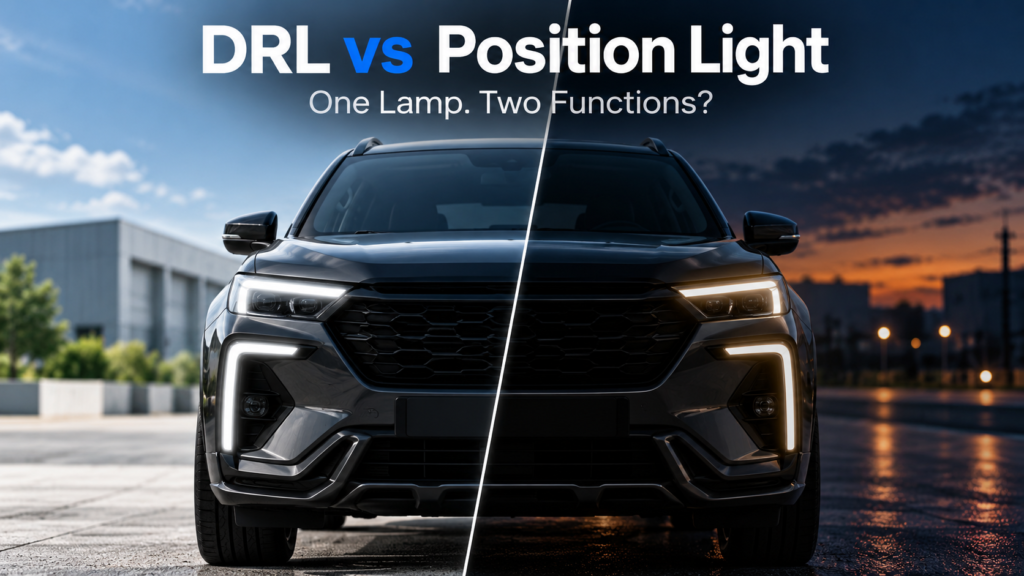
Cover illustration: an SUV shown in daylight and at dusk.
LED daytime running lights (DRLs) make a vehicle easier to notice during daylight. Front position lights indicate its presence and width at a lower intensity. They are different lighting functions, but a lamp designed and approved for both can perform them in the same housing. Neither function replaces the headlamps needed to illuminate the road.
The useful buying question is whether the exact lamp provides the function your vehicle needs, with the right control behaviour and evidence for your market. A bright LED strip, a dimming wire or the word “DRL” on a listing cannot answer that question alone.
DRL vs position light: the practical differences
This comparison concerns the front position light. Rear position lights, often called tail lights, mark the rear of the vehicle; they are a separate part of the lighting system.
| What to compare | Daytime running light | Front position light |
|---|---|---|
| Main job | Make the vehicle conspicuous in daylight | Indicate the vehicle’s presence and width |
| Light level | A daytime conspicuity function with its own photometric requirements | A lower intensity position function with its own requirements |
| Road illumination | Does not replace a headlamp | Does not replace a headlamp |
| Typical operation | Automatically controlled by the vehicle or an appropriate controller | Operates as part of the vehicle’s position lighting system |
| Shared housing | May share a housing or light source with other functions | May be provided by a suitable combined DRL/position lamp |
| Buying evidence | Exact DRL function, permitted colour, control logic and applicable compliance documentation | Exact position function, permitted colour, control logic and applicable compliance documentation |
“LED” describes the light source. It does not establish whether a device is a DRL, position lamp, turn signal or decorative accent. The intended function and the applicable requirements do that.
Can one lamp be both a DRL and a position light?
Yes, when that exact lamp is designed to provide both functions. A combined design may use a brighter daytime mode and a lower intensity position mode. Another design may turn the DRL function off and use a separate position lamp. Do not assume every installation must behave identically.
There is a real hardware distinction behind the labels. HELLA’s 90 mm lamp range lists DRL-only versions and versions with both daytime running and position lighting. Its left-side DRL-only part is 2PT 009 599-111; the left-side combined version is 2PT 009 599-131. Similar appearance does not make the supplied versions interchangeable.
A dimmer added to a DRL does not, by itself, establish an approved position function. UN Regulation No. 148, paragraphs 3.2.1–3.2.2, requires the relevant functions in a combined unit to satisfy their applicable provisions. Check the exact version and its documentation before replacing an existing lamp.
What should happen when other lights switch on?
Check the vehicle manual and the lamp’s installation instructions together. These are the operating states to verify, rather than a universal wiring diagram:
| Vehicle state | What to establish before installation |
|---|---|
| Daylight running | When the DRL starts operating and which other lamps illuminate |
| Position lighting selected | Which front and rear position lamps operate; whether the combined lamp changes function |
| Dipped-beam headlamps selected | Whether the DRL function switches off or transitions to a supported position function |
| Turn signal or hazards active | Whether the neighbouring or combined light changes operation as required for that configuration |
| Propulsion system off | Whether the lighting shuts down or provides an intended parking function |
The UK car and passenger vehicle MOT manual, section 4.2, recognises different behaviours where DRLs serve as front position lamps. It also checks position lighting together with the relevant rear and registration plate lighting. This is UK inspection guidance, not a universal retrofit approval recipe.
Front DRLs being lit does not prove your tail lights are on. Verify the actual vehicle. A bright dashboard or illuminated front signature is also insufficient evidence that the correct headlamp and rear-light modes are active.
Do not guess pin functions from wire colours or connect a control input directly to an unfamiliar vehicle circuit. Ask for the model-specific connection diagram, supply requirements and controller compatibility. A body control module may need a particular input or coding procedure.
Position lights, sidelights and parking lights: check the market
These names overlap in conversation, but regulatory categories should not be treated as interchangeable.
In UN approval documentation, the published 2021 text of UN Regulation No. 148 consolidates several earlier light-signalling regulations, including Nos. 7, 50 and 87. Its Table 1 identifies DRLs as RL, front position lamps as A, and category L front position lamps as MA. Use the approval documentation to identify the actual function and vehicle category. An E approval identifier alone is not a complete description of what the lamp is approved to do.
In the United States, FMVSS No. 108 uses the term parking lamps for a defined front-lighting function. Section S6.1.1.4 addresses automatic DRL wiring for passenger cars, multipurpose passenger vehicles, trucks and buses, excluding parking and fog lamps from that provision. Motorcycles are not included in that list. Do not turn a car DRL clause into a motorcycle installation rule.
For readers comparing candela figures, S7.10.13 sets a 500 cd minimum at H-V and a 3,000 cd maximum for the DRLs covered by its general requirement, with exceptions for lower-beam and specified upper-beam headlamps used as DRLs. These are regulated luminous-intensity conditions, not a universal product brightness range or a substitute for the full standard.
Device approval and vehicle installation are separate checks. UN installation requirements depend on vehicle category—for example, R48 and R53 are different frameworks. Confirm the applicable amendment series and national rules with the responsible approval or inspection authority. Older R7/R87 references should be checked in context rather than automatically accepted or rejected.
How to read a listing that says “with DRL”
Separate the main optic from the secondary lighting element. An auxiliary driving or work light may include a perimeter strip while its main beam performs a different job. The secondary element’s commercial name does not establish a road-approved DRL or position function.
For example, the DXZ 10-Inch Perimeter-DRL LED Driving Light, 10C03, is described as an auxiliary driving lamp with a main optic and a perimeter secondary light guide. That describes its configuration. It does not establish that the secondary element can replace your vehicle’s required front position lamps.
When browsing DXZ LED driving lights, request documentation for the precise SKU and variant. Confirm the emitted colour of each function, rather than inferring it from a product photo, a family name or the main beam’s colour. “Amber DRL” is a specification to investigate, not a universal road-use permission or proof of improved fog performance.
Five checks before you order
- State the vehicle and market. Give the make, model, year, vehicle category and country of use. Say whether the installation is for public roads or an off-road application.
- Name the required function. Specify DRL only, front position only, or a combined lamp. Identify the existing lighting that will remain or be replaced.
- Match the evidence to the supplied part. Request the function documentation, approval identifier where applicable, exact variant and installation instructions. A certificate for a different model cannot resolve the question.
- Confirm electrical and control compatibility. Establish supply voltage, current in each mode, input logic, connectors, protection and any required coding. Check headlamp and indicator interaction before committing to the installation.
- Check the installed result. Verify mounting orientation, visibility, permitted lamp arrangement and all operating states. Judge the complete vehicle system, not just whether the new lamp lights up on a bench.
For a DXZ project, send these details with your quotation request. Ask specifically which lighting functions and supporting documents are available for the proposed variant. This makes the response useful for selection and subsequent compliance review.
Frequently asked questions
Are DRLs brighter than position lights?
DRL mode is intended for daytime conspicuity; a front position function normally uses a lower intensity. Compare the specified function and test conditions, not LED count, wattage or an unqualified lumen figure.
Can I drive at night with only DRLs or position lights?
Neither is a replacement for the headlamps needed to illuminate the road. Select the appropriate headlamp and rear-light modes for conditions. The UK Department for Transport’s DRL guidance explains that dedicated DRLs are not intended to light the road in darkness and may dazzle when used at night.
Do automatic headlights mean I can remove a position light?
No. Automatic switching does not establish that all required lighting functions remain present and compliant. Check the vehicle’s approved configuration and the proposed replacement before removing or disabling a lamp.
Is every halo or LED strip a legal DRL?
No. Shape and ignition-controlled operation do not establish the required function. Check the exact lamp’s documentation, colour, control behaviour and suitability for the vehicle and market.
Sources and scope
Reviewed October 6, 2026. This guide explains lighting functions and purchasing checks; it does not certify a particular installation. The R148 link is the published 2021 text used for the function symbols and combined-device provisions, not a claim that every market applies that edition. The UK DRL explainer dates from 2010; the current MOT manual is used to qualify operating behaviour. Use current applicable requirements and model-specific documents for an installation decision.
Text version: Read this guide in Markdown.