Tractor Work Lights: How to Choose & Verify LED Lights
Tractor Work Lights: How to Choose and Verify LED Work Lights for Tractors
LED tractor work lights have to survive far more than a spec sheet admits — stone dust in the field, mud and pressure washing at the barn, hours of vibration, and a charging system that swings well above the nominal 12 V or 24 V. Choosing tractor work lights comes down to five things that decide whether they last: dust and water protection, thermal behaviour, usable voltage range, how well they hold aim, and the beam pattern for the job. This guide works through each of them, then shows the in-house test reports DXZ publishes for its own work-light models, so you can compare suppliers on measured evidence rather than adjectives.
What actually decides whether a tractor LED work light lasts
Most failures on agricultural machinery are slow, not dramatic, and they rarely appear in the first month. Dust works past a seal until the lens greys out. Condensation forms inside a housing overnight. A bracket drifts a few degrees until the beam no longer covers the row. A driver ages early because the housing runs hot in summer. Warranty wording rarely tells you which of these a supplier has actually tested.
| Failure mode | How it shows up on a tractor | Evidence that it was addressed |
|---|---|---|
| Dust ingress | Grey film inside the lens, LEDs visibly dimmer | Dust test to GB/T 10485-2025 (IP5X) |
| Water ingress | Beads or condensation after rain or washdown | Water test in a high-pressure spray rig |
| Overheating | Early LED failure, clouded or discoloured lens | Power and surface-temperature test at 12 V and 24 V |
| Vibration and aim drift | Beam creeps off the work area over a season | Mount vibration test reported with post-test photometry |
| Voltage extremes | Flicker on start, short service life | Wide-input rating, plus EMC or type-approval evidence |
| Cold-start condensation | Internal fog on cold mornings | Low-temperature and thermal-cycling test |
Field conditions on a tractor — and what each one asks of the light
Tractor lighting is not one environment. A light that performs in a dusty field is not automatically the right choice for a dairy barn washdown, and a light aimed at row-crop work is not automatically legal for the road journey between fields. Find the scenario closest to how your tractor work lights are actually used.
| Scenario | What the light actually meets | What to specify | Why it matters |
|---|---|---|---|
| Field and tillage work | Stone dust, soil, continuous vibration | Dust protection to IP5X or better; a bracket that retains aim | Dust film cuts output, and vibration walks the beam off the row |
| Road transport between fields | Regulated road illumination, voltage swings | An E-marked or R10 type-approved model where road lighting is required | On-road use is a legal question, not only a brightness one |
| Livestock and dairy barns | Pressure washing, slurry, cleaning chemicals | An enclosure tested in a high-pressure spray rig, with sealed connectors | A rain-only rating fails under a washdown hose |
| Orchard and vineyard rows | Branches, tight turns, spray drift | Compact flush-mount forms with dependable aim retention | Overhanging branches punish conventional brackets |
| Winter and cold starts | Sub-zero starts, condensation, thermal cycling | Documented low-temperature operation and a properly sealed housing | Fog inside a lens is a seal problem, not a lens problem |
Inside the DXZ lab: the tests behind a work-light claim
DXZ runs its own reliability laboratory and publishes the reports alongside the model they cover. The LP4.5C01 LED work light, for example, carries a set of in-house reports answering the four questions a tractor buyer asks most.
| Test | Report no. | Date | Method | Result |
|---|---|---|---|---|
| Dust ingress | DXZ202600908-001 | 2026-09-08 | GB/T 10485-2025 clause 10; 1 h with dry talc powder in a YX-IP56X-1000L dust chamber | Passed — IP5X |
| Water ingress | DXZ202600821-006 | 2026-08-21 | GB/T 10485-2025 water resistance; IPX9K high-pressure spray at 0.4 MPa, 35 cycles | Passed |
| Power and temperature rise | DXZ20260821-007 | 2026-08-21 | 12 V (13.2 V) and 24 V (28.0 V) for 1 h, infrared thermography | Surface 58.5 °C against a 90 °C limit; power within ±5 %; passed |
| Photometric (integrating sphere) | DXZ20260914-004 | 2026-09-14 | CT400 sphere with GO-QYHD2 detector, three repeats averaged | Flux within ±10 % of design; CCT within 6000 K ±1000 K; passed |
Electromagnetic compatibility and road-use approval sit outside that bench set. The H-9C-Y LED work light was tested for EMC to EN 55015 and EN 61547 by Guangdong KEYS Testing Technology Co., Ltd. (report RKEYS251128005, 12 December 2025). For on-road use, the H-F-16 LED work light holds UN Regulation No. 10 type approval E57*10R06/03*1476, which lists a rated system voltage of DC 12/24 V, negative ground.
Two limits are worth stating plainly. The LP4.5C01 dossier is a bench-level reliability set, not a tractor-mounted field trial, and no model-specific tractor vibration report has been published yet. Where a test has not been run, we say so — the suppliers worth avoiding are the ones who blur that line.
You can see the full method and the other published measurements in the in-house testing laboratory, and compare repeat measurements in the batch consistency test data.
| Item | What the evidence establishes |
|---|---|
| Dust ingress (GB/T 10485-2025 §10) | IP5X — pass. Dry talcum powder, 1 h, 23 °C. Report DXZ202600908-001 (8 Sep 2026). |
| Water / pressure washing (GB/T 10485-2025) | IPX9K — pass. 0.4 MPa high-pressure spray, 0°/30°/60°/90°, 35 cycles. Report DXZ202600821-006 (21 Aug 2026). |
| Power and temperature rise at 12 V / 24 V | Case surface 58.5 °C after 1 h lit, against a 90 °C limit (13.2 V and 28.0 V supply). Report DXZ20260821-007 (21 Aug 2026). |
| Photometric output (integrating sphere) | Flux within ±10% of design, colour temperature inside the 6000 K ±1000 K window. Report DXZ20260914-004 (14 Sep 2026). |
| EMC (EN 55015 / EN 61547) | Pass for the H-9C-Y family and its listed variants. Report RKEYS251128005 (Guangdong KEYS Testing, 12 Dec 2025). |
| UN R10 type approval | Approved for type H-F-16 at DC 12/24 V, negative earth. Approval E57*10R06/03*1476 ext. 00. |
Figure 1 — Every row is a report DXZ holds for the LP4.5C01 work light; each one names the model and sample it applies to.
Source: DXZ in-house reliability reports DXZ202600908-001, DXZ202600821-006, DXZ20260821-007 and DXZ20260914-004; Guangdong KEYS Testing report RKEYS251128005; UN R10 approval E5710R06/031476 (Guangdong DXZ Lighting Technology Co., Ltd.).
12 V or 24 V: matching tractor work lights to your electrical system
A tractor is normally described as a 12 V or 24 V machine, but the light never sees exactly that. A charging system sits above nominal voltage in normal running, and can dip hard during cranking. A work light that only tolerates its printed nominal voltage is a warranty claim waiting to happen.
DXZ publishes the applicable voltage range on each product manual rather than burying it in a sales sheet. The small square flood series is rated 9–32 V, the driving-light series 9–36 V, and the motorcycle series 9–80 V. The R10-approved H-F-16 is type-approved at DC 12/24 V, negative ground. For 12 volt LED tractor lights, the number that matters is the charging voltage the lamp is actually tested at rather than the label on the box — on the LP4.5C01 that was 13.2 V on the 12 V side and 28.0 V on the 24 V side.
Three details decide whether a tractor work light survives its first season:
- Fuse rating. Size the protection to the lamp’s actual current draw, not to a rule of thumb.
- Conductor size against route length. A long run to a rear-mounted lamp loses voltage, so match cross-section to the run and the connector losses.
- Switching method. Decide whether the lamp is fed through a relay, a dedicated switch, or the tractor’s own auxiliary circuit — and confirm the enclosure seals at the connector, which is where most water actually gets in.
If your tractor’s electrical architecture is unusual, send us the details — matching the wiring is part of what the OEM & ODM service covers.
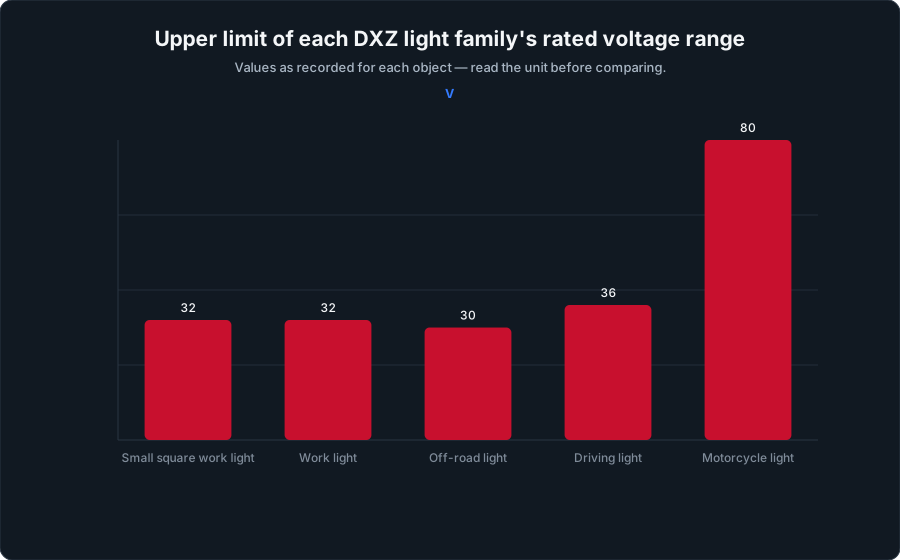
Figure 2 — Upper limit of each DXZ light family’s rated voltage range, read from the published product manuals.
Source: DXZ product manuals for the work light, small square work light, off-road light, driving light and motorcycle light (April 2026).
Where to mount lights on a tractor
The mounting position of lights on tractor equipment decides the beam you actually get, and how long it keeps pointing where you aimed it.
| Position | What it is good for | What to check |
|---|---|---|
| Cab roof | A wide forward flood that clears the hood line | Roof load rating; glare back off the windscreen |
| Front or hood bar | A low beam that sits close to the ground ahead | Impact exposure; heat from the engine bay |
| Fender or side | Side work and loader visibility | Mud and stone spray; cable routing behind the wheel |
| Rear or three-point | Implement and trailer work | Reversing-only switching; dust thrown up by the tyres |
Aim retention is the specification most often skipped. A bracket can be strong and still let the beam drift a few degrees over a season of vibration — which is why mount vibration testing is reported together with post-test photometry, not on its own. If a supplier offers only a generic "vibration tested" line with no beam measurement after the test, that claim is not checkable.
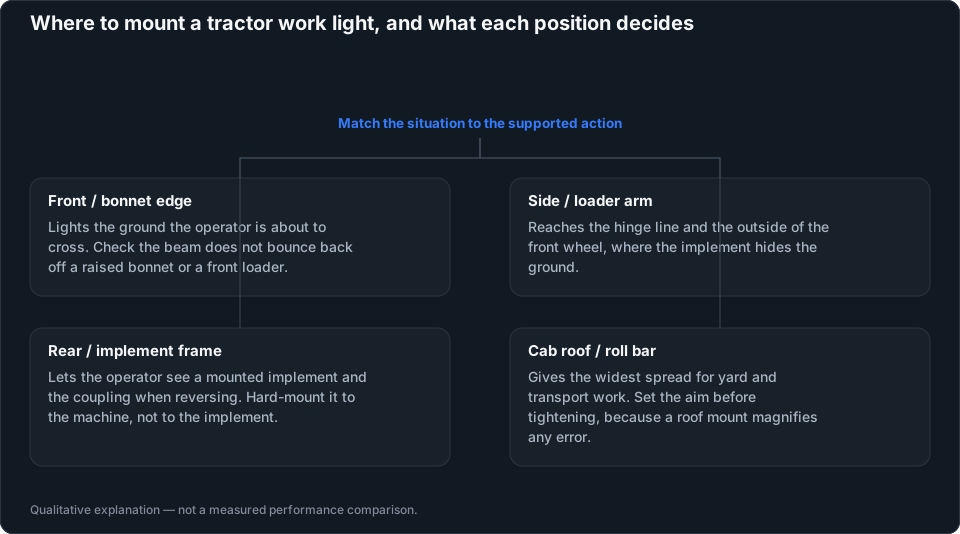
Figure 3 — Each mounting position lights a different part of the job — and each one fails differently.
Source: DXZ installation sections of the work light and off-road light manuals (April 2026).
Tractor light bar or individual work lamps?
LED tractor lights are sold in two common forms, and they solve different problems. A light bar gives a wide, even flood from a single mounting point, and is efficient when you want broad coverage ahead with one cable run. Individual work lamps can be aimed at specific tasks — one forward, one to the side for a loader, one to the rear for an implement — and can be replaced one at a time. Neither form is inherently better; tractor LED lights should be judged on their test evidence, not their shape. A common tractor setup is a wide bar forward plus one or two aimed lamps for side and rear work; typical forms appear in the 19-cell round flood and 42-cell dual-panel flood LED work lights.
How to compare suppliers: the evidence pack
Ask every supplier the same four questions about the tractor work lights you are considering, and the comparison stops being about adjectives.
| Claim | What a complete evidence pack shows |
|---|---|
| "Dust and waterproof" | An IP test report naming the standard, the rating, the test conditions, and the exact model |
| "Works on 12 V and 24 V" | The manual’s stated input range, plus the voltages actually tested |
| "Runs cool" | A measured surface temperature at the worst-case load |
| "Road legal" | A type-approval number, the model it names, and the voltage listed on it |
This is the same pack DXZ publishes for its own tractor work lights. If a supplier cannot produce it for the model you are buying, treat the claim as unverified.
| Item | What the evidence establishes |
|---|---|
| Dust and water test report | Proves ingress protection on the model and sample actually tested. It does not carry over to a different housing. |
| EMC report | Proves emissions and immunity to the named standard for the listed models only — check the model list on the report. |
| UN R10 approval | Proves type approval for the named type at the stated voltage and polarity. It is not a general licence for every lamp in the range. |
| Photometric (sphere) report | Proves flux and colour temperature sit inside the declared design tolerance. Compare the tolerance, not the adjective. |
| Temperature-rise report | Proves the case temperature measured at the stated supply voltage stayed under the limit for the test duration. |
Figure 4 — A report proves only what its scope says it proves. Read the scope line before you read the result.
Source: DXZ in-house reliability reports DXZ202600908-001, DXZ202600821-006, DXZ20260821-007 and DXZ20260914-004; Guangdong KEYS Testing report RKEYS251128005; UN R10 approval E5710R06/031476.
Frequently asked questions
What should I send DXZ to get a tractor work light recommendation?
Your machine type and voltage system, the mounting positions available, your working conditions (dust, washdown, cold), and the beam pattern you need. The request a quote form takes all of it in one message.
Are DXZ tractor work lights suitable for 24 V systems?
The wide-input series cover it — 9–32 V on the small square flood series and 9–36 V on the driving-light series — and the R10-approved H-F-16 is type-approved at DC 12/24 V, negative ground.
Do DXZ tractor work lights come with test reports?
The LP4.5C01 work light does — dust (DXZ202600908-001), water (DXZ202600821-006), power and temperature rise (DXZ20260821-007), and photometric (DXZ20260914-004) — plus EMC for the H-9C-Y and R10 type approval for the H-F-16.
Can one light cover both field work and road transport?
They are different jobs. Field work usually wants a wide flood aimed at the task, while on-road use depends on the model holding R10 type approval — off-road capability on its own does not establish road-use compliance.
What does IP5X mean for a tractor work light?
The "X" means the light is not classified for water at all, and the "5" means it is dust-protected. An IP5X result on its own therefore tells you nothing about washdown — ask for the water test as a separate report.
Conclusion
Choosing tractor work lights is easier once you know which five properties actually matter and which tests stand behind them. Ask for the evidence pack, match the light to the scenario you work in, and match the wiring to your tractor’s real electrical system. When a supplier publishes lab results rather than marketing lines, the decision makes itself.
Next step
Need work lights with the test reports attached? DXZ manufactures tractor work lights and the wider LED work-light range for agricultural machinery, and publishes the reliability reports for its models. Request a quote or talk to our OEM & ODM team about a specific tractor configuration.
Sources and test reports
- DXZ in-house reliability laboratory, Guangdong DXZ Lighting Technology Co., Ltd. — reports DXZ202600908-001, DXZ202600821-006, DXZ20260821-007, DXZ20260914-004 (2026).
- Guangdong KEYS Testing Technology Co., Ltd. — report RKEYS251128005, 12 December 2025 (EN 55015 / EN 61547).
- UN Regulation No. 10 — type approval E57*10R06/03*1476; technical service AUTOMOTIVE TECHNICAL SERVICE S.r.l.
- GB/T 10485-2025 — road vehicle lighting, dust and water test clauses.
- ISO 20653:2023 — road vehicles, degrees of protection (IP code).
- SAE J581 — auxiliary high-beam lamps (test procedures and performance requirements).