
Forklift Lighting Checks for Warehouse Aisles and Crossings
By DXZ Lighting · Updated
Check forklift lighting from the operator’s seat and from the routes where pedestrians approach. Use the normal load and facility lighting, then repeat at the aisle crossings, turns and doorways the truck uses. Record which task surface or warning cue becomes difficult to see and what needs adjusting.
This is a checklist for installed lighting. If you are selecting a lamp or changing its function, start with the forklift lighting buyer guide. Keep three parts of the warehouse in view: fixed facility lighting, the truck’s white task lighting and any floor warning projection.
Prepare a controlled check
Have the site’s responsible operator and maintenance or safety staff agree on the route, load positions and observation points. Keep observers in designated safe positions while an authorized operator follows the site procedure. Use a stationary check for close inspection of the lamp and mount.
Record the truck ID, lamp model, mounting position, control mode, load and facility-lighting state. Include the specific crossing or rack position. This gives the maintenance team enough information to repeat the check after an adjustment.
Use this proposed inspection record alongside the truck instructions and the site’s traffic assessment.
Can the operator see the handling task with a load?
From the seat, check the fork tips, pallet entry points and surfaces used to judge placement. Observe the view with the mast and load in the normal positions for the task. A clear empty-truck view is only one part of that check.
Toyota’s lighting-options guide notes that an inset headlight position can allow the mast to obstruct the beam. When a shadow covers the task, record the mast position and the affected surface before changing the lamp aim or mount.
| Observation | Record it this way | Next review |
|---|---|---|
| Fork tips disappear into shadow | State the load and mast position, and which tips are obscured | Beam path, lamp position and aim |
| Pallet openings are difficult to distinguish | Identify the rack position, pallet face and facility-lighting state | Coverage of the task surface and fixed lighting |
| A lamp works with an empty truck but loses coverage with the normal load | Record the change in view with that load | Obstruction and the available mounting arrangement |
| A bright patch sits beyond the handling surface | Identify the surface that still needs light | Aiming and beam distribution at the task |
Review the beam on the work area before ordering a higher-output replacement. The DXZ forklift light range gives model and function choices for that discussion.
Is the warning visible from the crossing approach?
Observe the floor projection from the pedestrian route, in each direction used to approach the crossing. Mark the point where the observer first sees the cue under the checked conditions. Include rack contents, parked equipment and doorway positions in the record.
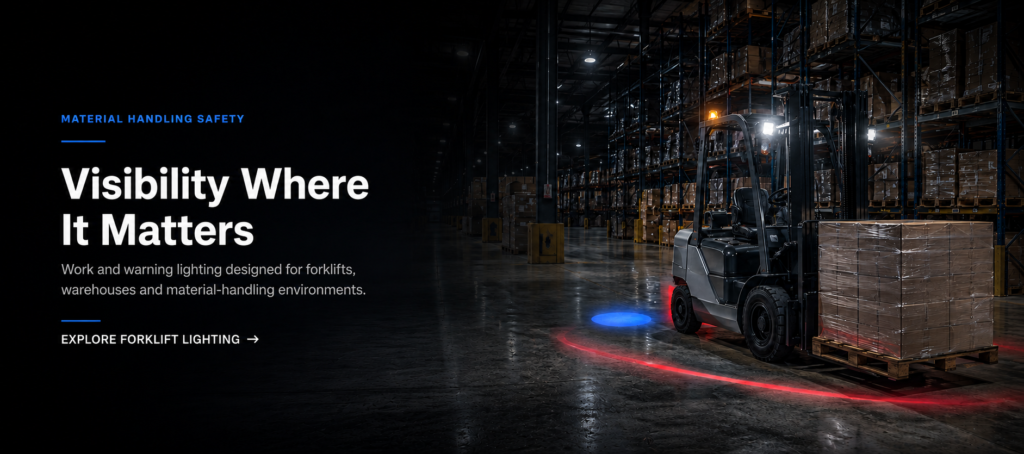
A blue spot, red line or arc gives a different pattern to look for. Record the actual pattern and its placement. If it disappears behind a rack or lands outside the observer’s view, identify that location for review with the traffic plan.
At a turn, repeat the observation from the designated safe positions as the truck follows the approved route. Check what is visible beside the truck and at the rear approach. Set pedestrian clearance through the site’s assessment and record where the floor line falls during the lighting check.
OSHA’s pedestrian-traffic guidance recommends separating forklift traffic and pedestrians where possible, with walkways or barriers, mirrors at blind intersections and traffic controls. Keep those measures in the inspection record alongside the warning lights.
Does glare interfere with the view?
Check from the seat in the travel directions used on the route, including reversing. Look for distracting light in the mirrors or cab glass and reflections at the task. From pedestrian observation points, check whether the lamp faces people directly.
The UK HSE lighting guidance discusses tall vehicles blocking lighting and the need to position strong lights so they do not dazzle reversing drivers, directly or through mirrors. Use the observation to identify the lamp, reflection and viewing position that need review.
After an aiming change, return to the task and crossing checks. Record whether the adjustment resolves the original issue and whether coverage remains useful elsewhere on the route.
Does the result hold through the working shift?
Repeat relevant observations when the conditions change during normal work. Examples include daylight at an open dock door, a different load, or a cleaned floor. Note the condition instead of recording a general statement such as “the light is visible.”
| Condition to record | Question for the check |
|---|---|
| Facility lights and daylight | Can the operator see the task and the observer see the intended cue? |
| Floor finish and condition | Where is the projection visible, and where does it become hard to distinguish? |
| Load and mast position | Which task surfaces or beam paths become obscured? |
| Lens condition | Is the cover clean and unobstructed? |
| Cold-store transition, where relevant | Does moisture or frost affect the view after the normal transition? |
HSE’s lighting guidance calls for lights to be maintained and covers kept clean. Include that maintenance check before judging a lamp’s performance from a dirty lens.
Which US forklift lighting requirements belong in the check?
29 CFR 1910.178(h)(2) requires auxiliary directional lighting on the truck where general lighting is below 2 lumens per square foot. Section 1910.178(n)(4) addresses slowing down and sounding the horn at cross aisles and obstructed-vision locations; (n)(6) addresses a clear view in the direction of travel.
OSHA’s November 2012 interpretation says the standard does not specifically require flashing lights or back-up beepers. It also addresses the employer’s duty to mitigate recognized forklift hazards. Select and maintain additional warnings through the workplace assessment and applicable requirements.
Use those requirements to organize the review. A visible ground cue does not establish the operator’s clear view or complete the traffic-control assessment.
What should the inspection record contain?
Keep the record specific enough for someone else to repeat the observation:
- Identify the truck, lamp and installation, including the mounting and control settings.
- Name the task or crossing and the observation position.
- State the load, mast position, floor condition and available light.
- Describe the problem and the proposed adjustment, with a photo or sketch if useful.
- Assign the follow-up, record the recheck date and retain the result.
For example, “the projected line was not visible from the marked walkway with the dock door open” gives the team a repeatable issue to investigate. This is an illustrative record entry, not a customer test result.
If the recheck requires another beam or projection pattern, send the record to DXZ with the truck and supply details. Use the selection guide to narrow the lighting function and the contact page for a configuration review. Include any bracket or connector changes when discussing an OEM or ODM assembly.
Download forklift-light documents
- FCC Supplier’s Declaration of Conformity, February 2, 2026 (PDF)
- CE-EMC Certificate of Conformity, November 16, 2022 (PDF)
- RoHS Certificate of Conformity, November 16, 2022 (PDF)
The PDFs include their issue dates and model lists. Contact DXZ with the SKU and destination market for the latest model-specific documents.