Choosing the right automotive LED light is not only about wattage or lumen output. Beam pattern, usable illuminance, mounting position, operating environment and electrical compatibility all affect how the light performs.
Use this guide to understand the core principles behind automotive, off-road and machinery lighting, then compare the DXZ product range and model-specific data for your application.
BEAM PATTERNS
LED Light Beam Patterns: Spot, Flood, Driving & Combo
Beam pattern describes where the light goes. Two LED lights with similar output can create very different visibility because their optics distribute intensity differently.
Start with the required distance and coverage, then compare the actual beam image and illuminance data for the DXZ model.
Spot Beam
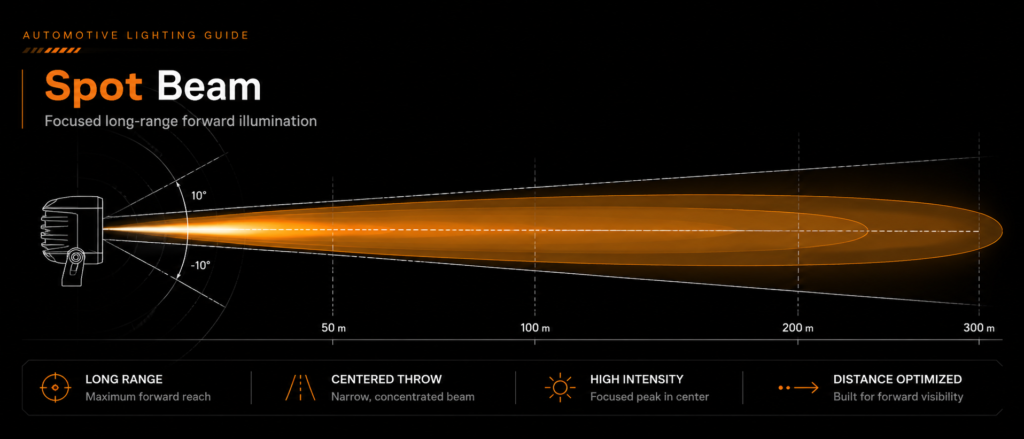
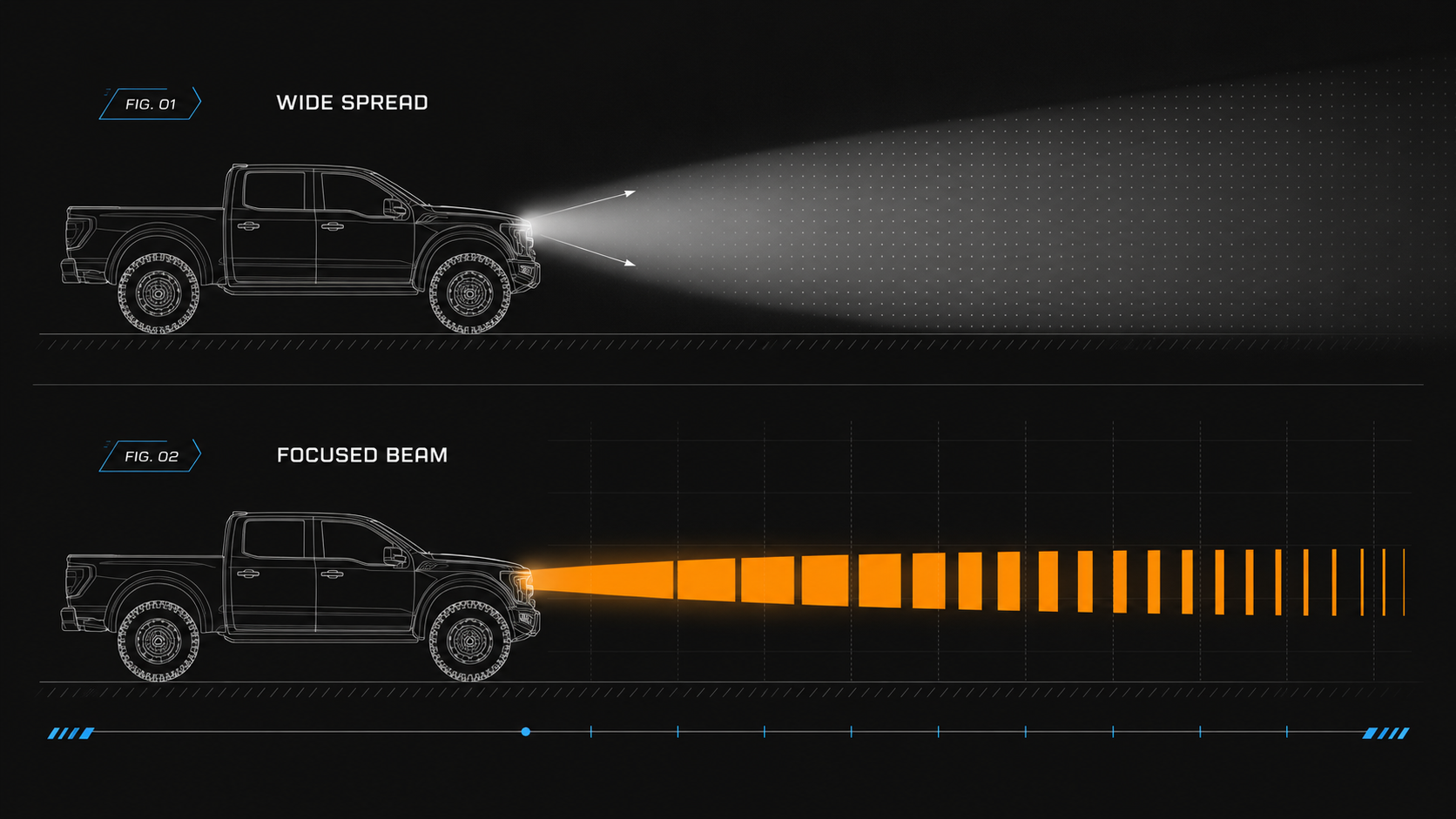
Focused light for long-range forward visibility. A spot beam concentrates intensity into a narrower field, extending useful illumination farther ahead while providing less peripheral coverage.
Best for: Long-range auxiliary lighting · Open terrain · Forward visibility
Hyper Spot Beam
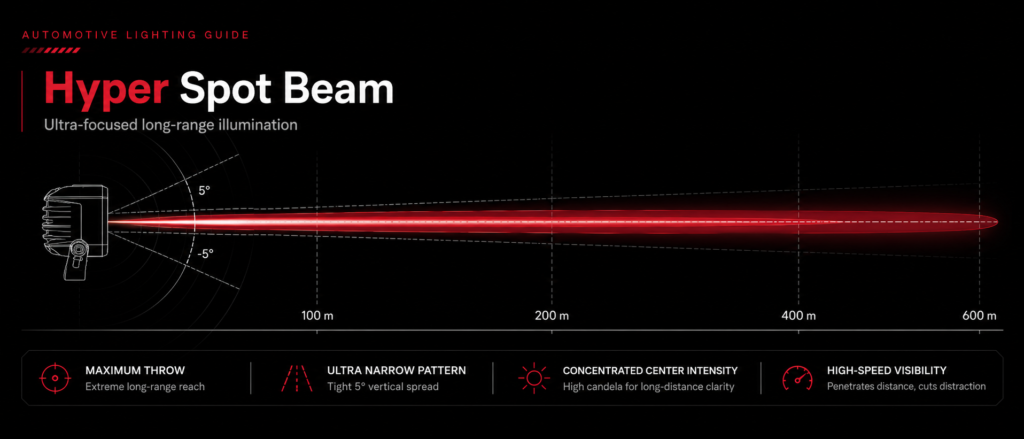
Maximum concentration for extended center reach. Hyper spot is a commercial term for an especially narrow beam pattern designed to concentrate more intensity toward the center. Actual beam width and distance vary by optical design.
Best for: Very long-range visibility · Open high-speed environments
Flood Beam
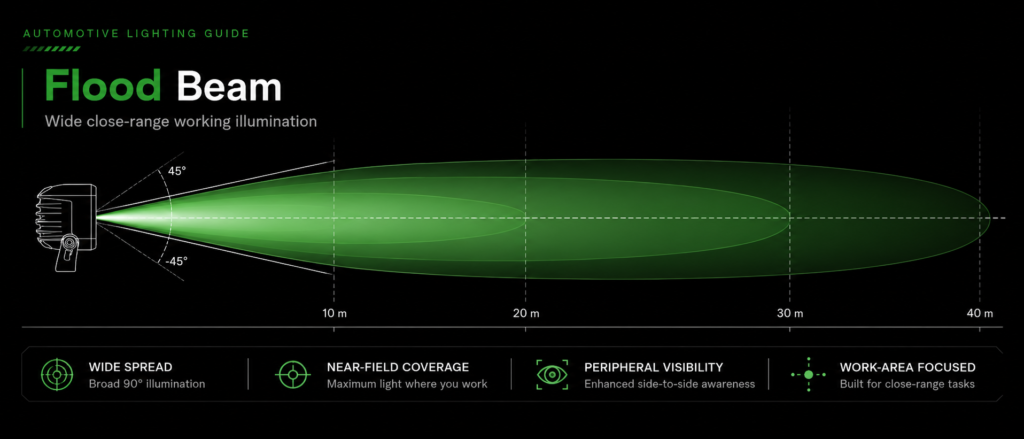
Wide illumination for nearby working areas. A flood beam spreads light across a broader field, favoring near-field and side-area coverage rather than maximum distance.
Best for: LED work lights · Construction · Agriculture · Work areas
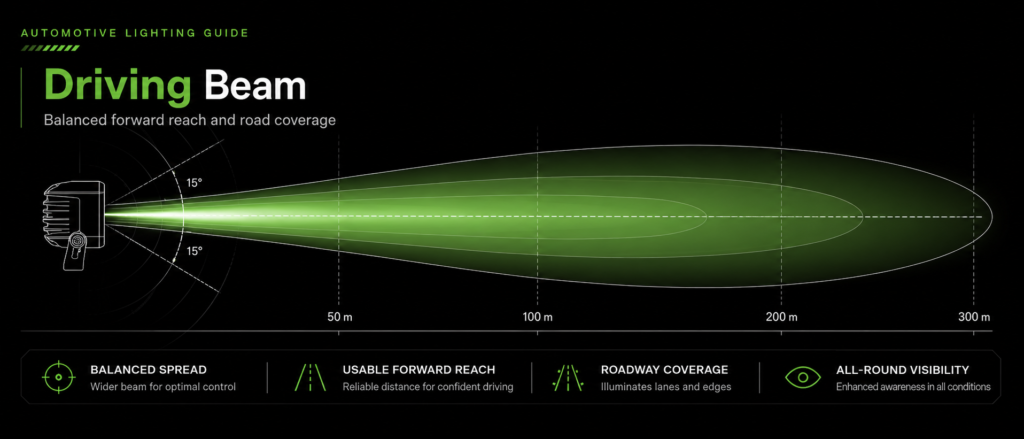
Driving Beam
Forward reach with usable width. A driving beam provides a broader forward field than a narrow spot while retaining useful distance. Exact distribution varies by model and optical system.
Best for: Auxiliary driving lights · Mixed road and off-road conditions
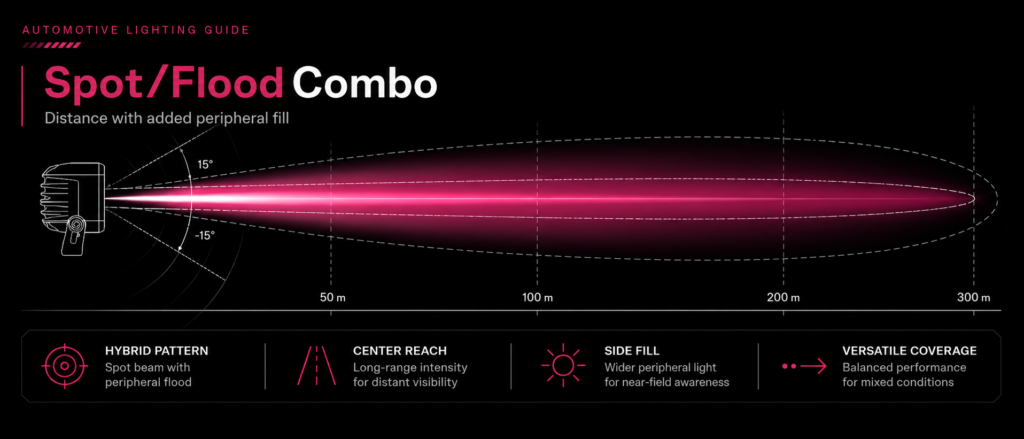
Spot / Flood Combo Beam
Distance and peripheral coverage in one pattern. A combo beam combines concentrated center illumination with a wider surrounding field, helping cover both distant terrain and nearby areas.
Best for: Off-road lighting · Mixed-speed driving · Multi-purpose auxiliary lighting
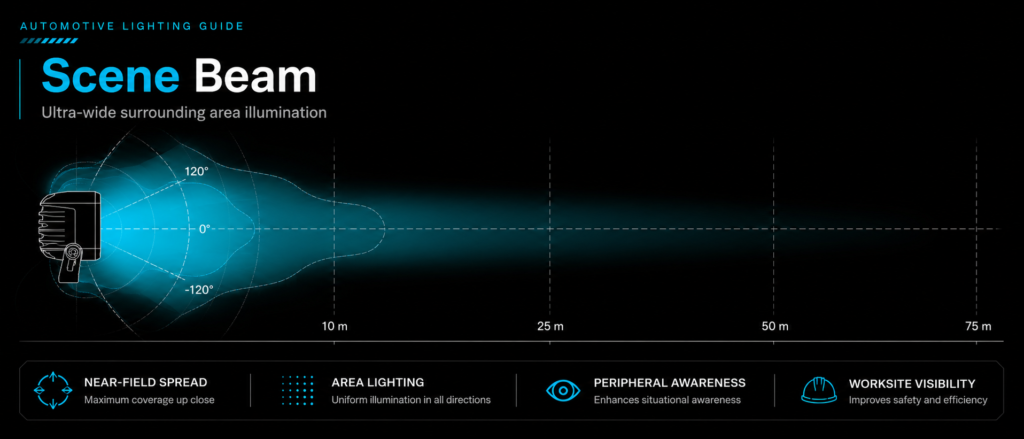
Scene Beam
Wide-area illumination around vehicles and equipment. Scene lighting prioritizes broad close-range coverage rather than forward throw.
Best for: Worksites · Loading areas · Service vehicles · Around-vehicle lighting
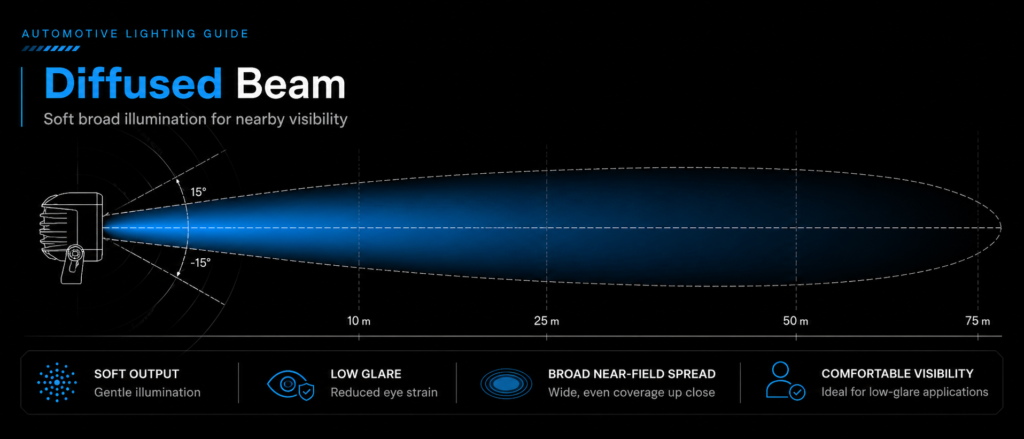
Diffused Beam
Soft, even illumination at close range. A diffused pattern spreads light broadly with less emphasis on a concentrated center hot spot.
Best for: Rear work · Equipment areas · Close-range tasks
Spot vs Flood — Quick Selection
Need distance? Start with Spot.
Need width? Start with Flood.
Need distance and width? Compare Driving or Combo.
Need surrounding-area illumination? Compare Scene or Diffused.
CHOOSE LIGHTS
How to Choose Automotive LED Lighting
The best light is determined by the visibility problem, not by the largest wattage or lumen number.
Start with Distance
Long-range driving and open terrain need controlled forward intensity. Close-range work normally benefits more from wider usable coverage.
Then Consider Width
A wider beam improves side and work-area visibility, while a concentrated beam keeps more intensity farther ahead.
Match the Operating Speed
At higher speeds, useful forward distance becomes more important. At lower speeds, terrain detail, peripheral visibility and nearby coverage become more valuable.
Check the Mounting Position
Mounting height, beam aim, vehicle bodywork and available installation space affect where the light actually lands.
Lighting Around the Vehicle or Equipment
A complete lighting setup may require different functions in different zones.
Forward — Driving, spot or combo lighting for down-road visibility.
Side / Work Area — Flood or work lighting for machinery and task areas.
Rear / Loading — Controlled close-range lighting for loading, maneuvering and service work.
Safety / Warning — Warning or material-handling lights when the objective is conspicuity rather than ground illumination.
LED Driving Lights · LED Work Lights · Off-Road Lights · Forklift Lights · Warning Lights
Application galleries — see these lights fitted in real use: Offroad / ATV / UTV · Truck / Trailer · Motorcycle · Engineering / Agriculture / Mining
AMBER / WHITE
Amber vs White LED Lights
Light color changes how a scene appears, but it does not replace good optics or correct beam placement.
White Light
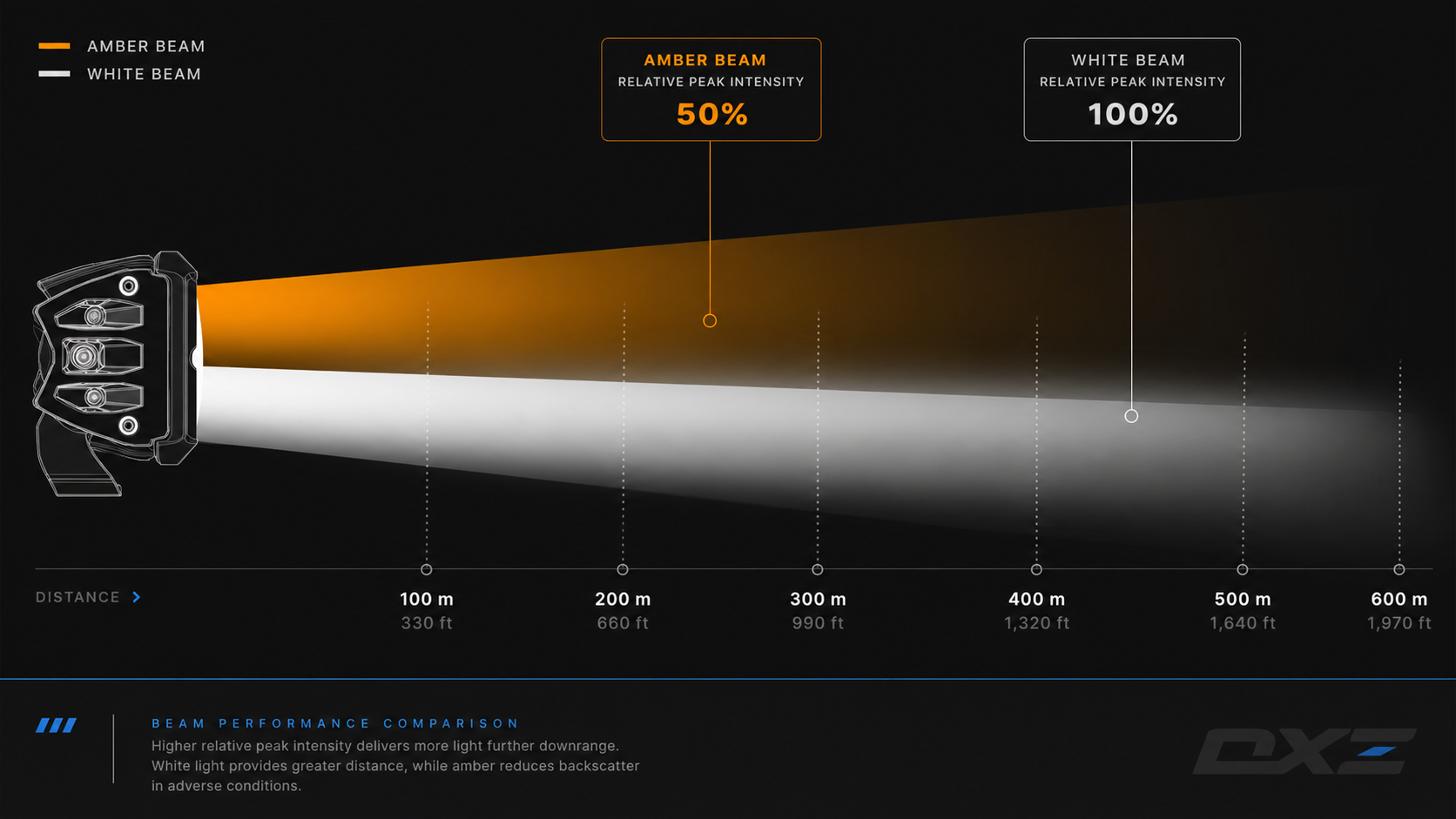
White LED lighting is widely used for forward and work illumination where clear visual detail and familiar color recognition are priorities. Color temperature varies by product, so compare the exact model rather than treating all white LEDs as identical.
Yellow / Amber Light
Yellow or amber lighting is often considered for dust, fog, rain, snow and other visually difficult environments. Its real-world effect still depends on beam pattern, intensity, mounting position and atmospheric conditions.
Which Should You Choose?
Choose the lighting task and beam pattern first, then select light color. White is not automatically better in every clear-weather application, and an amber beam does not correct poor optical control or incorrect aiming.
LIGHT METRICS
Lumens vs Lux vs Candela
Lighting numbers measure different parts of performance. No single figure describes the complete beam.
Lumens — Total Light Output
Lumens measure total visible luminous flux. A higher lumen value means more total light output, but it does not tell you where that light is distributed.
Lux — Light Reaching a Surface
Lux measures illuminance at a surface. It helps show how much usable light reaches a defined location or distance.
Candela — Directional Intensity
Candela measures luminous intensity in a specific direction. A concentrated beam can produce high candela and strong long-range performance without having the highest total lumen output.
CCT — Light Appearance
Correlated color temperature, measured in Kelvin, describes whether white light appears warmer or cooler. It does not directly measure brightness or beam distance.
1 Lux Distance
A 1 lux distance identifies the point where measured illuminance reaches 1 lux under the stated test conditions. It can help compare forward reach when the measurement methods are comparable.
DXZ Photometric Testing
DXZ uses integrating sphere measurement and dark-room illuminance testing to evaluate lighting performance.
For product selection, compare measured output, beam distribution and test conditions together rather than relying on theoretical LED-chip lumens alone.
POWER BASICS
LED Light Power: Wattage, Voltage & Amperage
Lighting performance and electrical compatibility should be evaluated separately.
Wattage (W)
Wattage describes electrical power consumption. It helps estimate electrical load, but higher wattage does not automatically mean better usable illumination.
Voltage (V)
The lamp must operate within its specified input-voltage range. DXZ voltage compatibility varies by model, so always check the exact product specification.
Amperage (A)
Amperage describes the electrical current drawn by the lamp. For a simple DC estimate: Current = Power ÷ Voltage. Use verified product current data when planning the final circuit.
12V / 24V LED Lighting
12V and 24V electrical systems are common across passenger vehicles, commercial vehicles, off-road platforms and machinery.
Compatibility is still model-specific. Check voltage range, current draw, wiring, fuse or relay requirements and available accessory capacity before installation.
ROAD USE
Road Use & Automotive Lighting Compliance
Automotive-lighting requirements vary by country, market, lighting function and installation position.
A product’s beam name, brightness, color or appearance does not by itself confirm that it is approved for public-road use.
For regulated on-road applications, verify:
- the exact DXZ model;
- target market;
- intended lighting function;
- installation and switching requirements;
- available certification or homologation documents.
DXZ can review available model documentation for B2B projects based on the intended market and application.
Need Help Choosing the Right Lighting?
Share your vehicle or equipment type, operating environment, mounting position, electrical requirements and target market.
DXZ can recommend an existing lighting platform or discuss an OEM / ODM configuration for your project.